Hardware-in-the-Loop Testing Patterns: From Automotive to IoT
Hardware-in-the-Loop (HIL) testing puts real firmware under test by simulating the physical environment it would operate in.

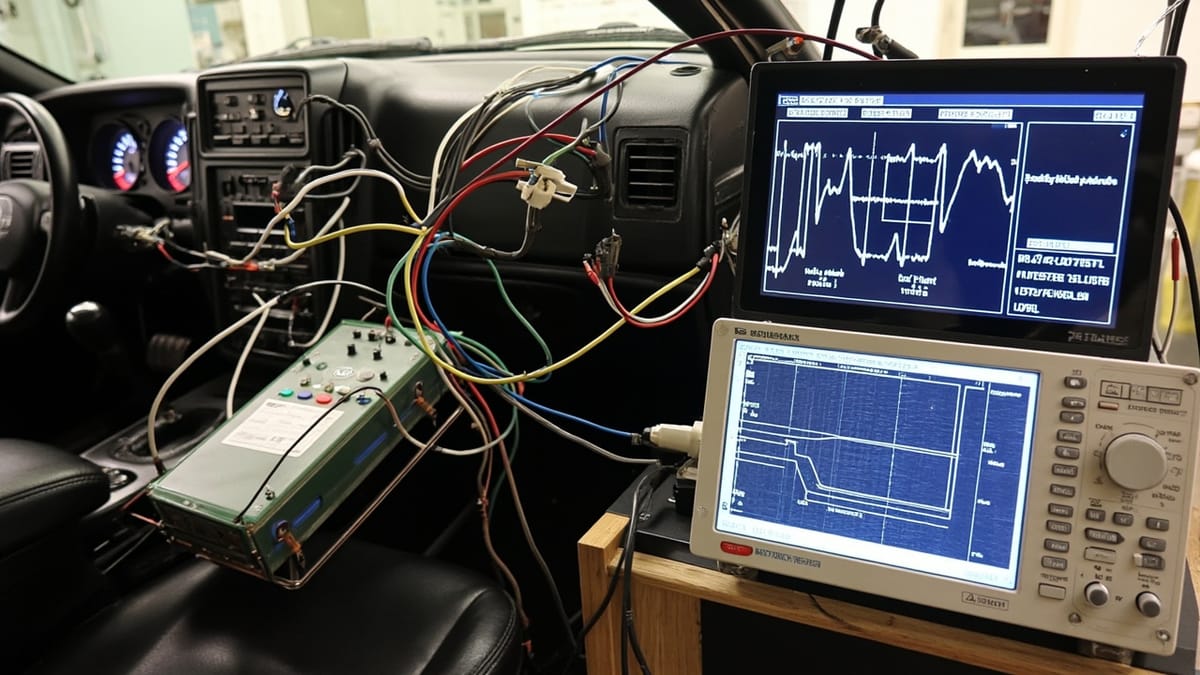
Hardware-in-the-Loop (HIL) testing puts real firmware under test by simulating the physical environment it would operate in. While basic HIL setups test simple I/O, production-grade HIL rigs implement sophisticated patterns for automotive ECUs, industrial controllers, and IoT devices. This guide covers the architectural patterns that make HIL testing scalable and reliable.
HIL Architecture Layers
A production HIL rig has four distinct layers:
┌─────────────────────────────────────────────┐
│  Test Orchestration Layer                    │
│  (Python/Robot Framework test scripts)       │
├─────────────────────────────────────────────┤
│  Signal Management Layer                     │
│  (stimulus generation, capture, analysis)    │
├─────────────────────────────────────────────┤
│  Hardware Interface Layer                    │
│  (DAQ cards, CAN interfaces, serial, GPIO)   │
├─────────────────────────────────────────────┤
│  Device Under Test (DUT)                     │
│  (your ECU, microcontroller, or IoT device)  │
└─────────────────────────────────────────────┘Each layer has a well-defined interface. This separation lets you swap hardware interfaces without rewriting test scripts.
Pattern 1: Stimulus-Response Testing
The most common HIL pattern: generate a stimulus, observe the DUT's response, validate against spec.
# hil/patterns/stimulus_response.py

from dataclasses import dataclass
from typing import Callable, Any
import time

@dataclass
class Stimulus:
    name: str
    channel: str
    waveform: list  # [(time_s, value), ...]

@dataclass
class ExpectedResponse:
    channel: str
    condition: Callable[[float], bool]
    timeout_s: float
    description: str

class StimulusResponseTest:
    def __init__(self, daq, dut):
        self.daq = daq
        self.dut = dut

    def run(self, stimuli: list[Stimulus],
            responses: list[ExpectedResponse]) -> dict:
        results = {}

        # Apply all stimuli
        for stim in stimuli:
            self.daq.program_waveform(stim.channel, stim.waveform)

        # Start capture
        self.daq.start_capture()

        # Start stimulus playback
        self.daq.start_playback()

        # Check each expected response
        for resp in responses:
            deadline = time.time() + resp.timeout_s
            captured = False

            while time.time() < deadline:
                value = self.daq.read(resp.channel)
                if resp.condition(value):
                    captured = True
                    break
                time.sleep(0.001)  # 1ms polling

            results[resp.channel] = {
                'passed': captured,
                'description': resp.description
            }

        self.daq.stop()
return results# Example: test fan turns on when temperature exceeds threshold
test = StimulusResponseTest(daq=my_daq, dut=my_ecu)
results = test.run(
stimuli=[
Stimulus(
name="temperature_ramp",
channel="analog_out_0", # connected to temp sensor input
waveform=[
(0.0, 20.0), # 20°C at t=0
(5.0, 20.0), # hold at 20°C for 5s
(5.1, 80.0), # step to 80°C (above threshold)
(15.0, 80.0), # hold
]
)
],
responses=[
ExpectedResponse(
channel="digital_in_2", # fan control output
condition=lambda v: v > 3.3, # logic high
timeout_s=1.0, # should respond within 1 second
description="Fan enables within 1s of temp exceeding 75°C"
)
]
)
assert results["digital_in_2"]["passed"], "Fan did not activate on overheat"Pattern 2: Fault Injection
Systematically inject hardware faults to validate DUT error handling:
# hil/patterns/fault_injection.py

from enum import Enum

class FaultType(Enum):
    OPEN_CIRCUIT = "open"       # Disconnect signal
    SHORT_TO_GND = "short_gnd"  # Pull signal to 0V
    SHORT_TO_VCC = "short_vcc"  # Pull signal to VCC
    OUT_OF_RANGE = "oor"        # Apply value outside valid range
    INTERMITTENT = "intermittent"  # Toggle rapidly

class FaultInjector:
    def __init__(self, relay_board, daq):
        self.relay = relay_board
        self.daq = daq

    def inject(self, channel: str, fault: FaultType,
               duration_s: float = None):
        """Inject fault and optionally auto-restore."""

        if fault == FaultType.OPEN_CIRCUIT:
            self.relay.open(channel)
        elif fault == FaultType.SHORT_TO_GND:
            self.relay.short_to_gnd(channel)
        elif fault == FaultType.SHORT_TO_VCC:
            self.relay.short_to_vcc(channel)
        elif fault == FaultType.OUT_OF_RANGE:
            self.daq.set_voltage(channel, 6.0)  # 6V on 5V system
        elif fault == FaultType.INTERMITTENT:
            self._intermittent_fault(channel, duration_s)
            return

        if duration_s:
            time.sleep(duration_s)
            self.restore(channel)

    def restore(self, channel: str):
        self.relay.restore(channel)
        self.daq.restore(channel)

    def _intermittent_fault(self, channel: str, duration_s: float):
        deadline = time.time() + duration_s
        while time.time() < deadline:
            self.relay.open(channel)
            time.sleep(0.05)
            self.relay.restore(channel)
time.sleep(0.05)# Test: DUT handles sensor open-circuit fault gracefully
class SensorFaultTest:
def test_open_circuit_sets_fault_code(self, hil_fixture):
dut = hil_fixture.dut
injector = hil_fixture.fault_injector
can_reader = hil_fixture.can_reader
# Baseline: sensor reading valid
assert dut.read_diagnostic() == "NO_FAULT"
# Inject open circuit on temperature sensor
injector.inject("temp_sensor", FaultType.OPEN_CIRCUIT)
# DUT should detect and report fault within 500ms
time.sleep(0.5)
# Read fault code via CAN diagnostic message
dtcs = can_reader.read_dtcs()
assert "P0118" in dtcs, "Temperature circuit high fault not set"
# Restore fault and verify DUT clears code
injector.restore("temp_sensor")
time.sleep(1.0)
dtcs = can_reader.read_dtcs()
assert "P0118" not in dtcs, "DTC not cleared after fault removal"Pattern 3: Timing Validation
Real-time systems must respond within defined time windows:
# hil/patterns/timing_validator.py

import numpy as np
from dataclasses import dataclass

@dataclass
class TimingSpec:
    stimulus_channel: str
    response_channel: str
    min_delay_ms: float
    max_delay_ms: float
    stimulus_threshold: float
    response_threshold: float

class TimingValidator:
    def __init__(self, high_speed_daq):
        # Requires high sample rate: >= 100kHz for ms-level timing
        self.daq = high_speed_daq

    def measure_response_time(self, spec: TimingSpec,
                               num_samples: int = 100) -> dict:
        delays = []

        for _ in range(num_samples):
            # Capture both channels at high rate
            self.daq.start_synchronized_capture(
                channels=[spec.stimulus_channel, spec.response_channel],
                sample_rate_hz=100_000,
                duration_s=0.1
            )

            # Apply stimulus
            self.daq.pulse(spec.stimulus_channel, width_ms=50)

            # Wait for capture
            data = self.daq.get_capture()

            # Find stimulus edge
            stim = data[spec.stimulus_channel]
            resp = data[spec.response_channel]
            time_axis = data['time']

            stim_edge = self._find_rising_edge(stim, time_axis,
                                                spec.stimulus_threshold)
            resp_edge = self._find_rising_edge(resp, time_axis,
                                                spec.response_threshold)

            if stim_edge and resp_edge:
                delay_ms = (resp_edge - stim_edge) * 1000
                delays.append(delay_ms)

        delays = np.array(delays)

        return {
            'mean_ms': float(np.mean(delays)),
            'min_ms': float(np.min(delays)),
            'max_ms': float(np.max(delays)),
            'std_ms': float(np.std(delays)),
            'p99_ms': float(np.percentile(delays, 99)),
            'all_within_spec': bool(
                np.all(delays >= spec.min_delay_ms) and
                np.all(delays <= spec.max_delay_ms)
            ),
            'violations': int(np.sum(
                (delays < spec.min_delay_ms) | (delays > spec.max_delay_ms)
            ))
        }

    def _find_rising_edge(self, signal, time_axis, threshold):
        for i in range(1, len(signal)):
            if signal[i-1] < threshold and signal[i] >= threshold:
                return time_axis[i]
return None# Test relay driver meets timing spec
def test_relay_activation_timing():
timing = TimingValidator(daq=high_speed_daq)
spec = TimingSpec(
stimulus_channel="relay_coil_cmd",
response_channel="relay_contact",
min_delay_ms=5.0, # coil needs at least 5ms to energize
max_delay_ms=15.0, # must close within 15ms
stimulus_threshold=2.5,
response_threshold=2.5
)
result = timing.measure_response_time(spec, num_samples=50)
print(f"Relay timing: mean={result['mean_ms']:.2f}ms, "
f"p99={result['p99_ms']:.2f}ms")
assert result['all_within_spec'], (
f"Relay timing violations: {result['violations']}/50 samples "
f"outside [{spec.min_delay_ms}, {spec.max_delay_ms}]ms. "
f"Actual range: [{result['min_ms']:.2f}, {result['max_ms']:.2f}]ms"
)Pattern 4: State Machine Validation
Verify DUT progresses through correct state sequences:
# hil/patterns/state_machine_validator.py

from typing import Optional
import re

class StateMachineValidator:
    """Validates DUT state transitions via CAN messages or serial output."""

    def __init__(self, state_reader):
        self.reader = state_reader
        self.history = []

    def expect_sequence(self, expected: list[str],
                        timeout_s: float = 10.0) -> bool:
        """Wait for DUT to pass through all expected states in order."""
        expected_idx = 0
        deadline = time.time() + timeout_s

        while time.time() < deadline and expected_idx < len(expected):
            state = self.reader.get_current_state()

            if state != self.history[-1:]:  # New state
                self.history.append(state)

                if state == expected[expected_idx]:
                    expected_idx += 1

        return expected_idx == len(expected)

    def forbid_state(self, forbidden: str, duration_s: float) -> bool:
        """Verify DUT never enters a forbidden state during a period."""
        deadline = time.time() + duration_s

        while time.time() < deadline:
            state = self.reader.get_current_state()
            if state == forbidden:
                return False
            time.sleep(0.01)

return Truedef test_motor_startup_sequence():
validator = StateMachineValidator(can_state_reader)
# Trigger startup
hil.set_ignition(True)
# Must follow: INIT → SELF_TEST → IDLE → RUN
assert validator.expect_sequence(
["INIT", "SELF_TEST", "IDLE", "RUN"],
timeout_s=5.0
), f"Invalid startup sequence. Got: {validator.history}"
# Must never enter FAULT during normal startup
assert validator.forbid_state("FAULT", duration_s=5.0), \
"Motor entered FAULT state during normal startup"Pattern 5: Power Cycling and Reset Validation
# hil/patterns/power_cycle.py

class PowerCycleValidator:
    def __init__(self, power_supply, dut_monitor):
        self.psu = power_supply
        self.monitor = dut_monitor

    def stress_test(self, cycles: int, on_time_s: float,
                    off_time_s: float) -> dict:
        results = []

        for i in range(cycles):
            # Power on
            self.psu.set_output(True)
            time.sleep(on_time_s)

            # Capture state before power off
            state_before = self.monitor.get_state()

            # Power off
            self.psu.set_output(False)
            time.sleep(off_time_s)

            # Power on again
            self.psu.set_output(True)

            # Wait for DUT to boot
            boot_time = self._wait_for_ready(timeout_s=5.0)

            # Capture state after reboot
            state_after = self.monitor.get_state()

            results.append({
                'cycle': i,
                'boot_time_s': boot_time,
                'state_consistent': state_after == 'IDLE',
                'data_intact': self._verify_nvram()
            })

        return {
            'total_cycles': cycles,
            'all_boots_succeeded': all(r['boot_time_s'] is not None
                                        for r in results),
            'max_boot_time_s': max(r['boot_time_s'] or 0 for r in results),
            'nvram_integrity': all(r['data_intact'] for r in results),
            'results': results
}Integrating HIL into CI
# .github/workflows/hil-tests.yml
name: HIL Tests

on:
  push:
    branches: [main]
  workflow_dispatch:
    inputs:
      test_suite:
        description: 'Test suite to run'
        default: 'smoke'
        type: choice
        options: [smoke, regression, stress]

jobs:
  unit-tests:
    runs-on: ubuntu-latest
    steps:
      - uses: actions/checkout@v4
      - name: Run host-side unit tests
        run: pytest tests/unit/ -v

  hil-tests:
    runs-on: self-hosted
    needs: unit-tests
    environment: hil-rig

    steps:
      - uses: actions/checkout@v4

      - name: Reserve HIL rig
        run: ./scripts/reserve_rig.sh --rig stm32-rig-01 --timeout 30m

      - name: Flash firmware
        run: |
          cmake -B build -DTARGET=stm32f4
          cmake --build build
          ./scripts/flash.sh build/firmware.elf

      - name: Run HIL test suite
        run: |
          pytest tests/hil/ \
            -v \
            --hil-config=config/rig_stm32.yaml \
            --test-suite=${{ inputs.test_suite || 'smoke' }} \
            --junit-xml=hil_results.xml

      - name: Release HIL rig
        if: always()
        run: ./scripts/release_rig.sh --rig stm32-rig-01

      - name: Upload results
        uses: actions/upload-artifact@v4
        if: always()
        with:
          name: hil-test-results
path: hil_results.xmlSignal Conditioning and Calibration
Real HIL rigs require calibration before tests are reliable:
# hil/calibration.py

class RigCalibrator:
    def __init__(self, daq, reference_meter):
        self.daq = daq
        self.meter = reference_meter

    def calibrate_analog_inputs(self) -> dict:
        """Measure actual vs expected voltages and compute correction factors."""
        cal_points = [0.0, 1.0, 2.5, 4.0, 5.0]
        corrections = {}

        for channel in self.daq.analog_input_channels:
            corrections[channel] = []

            for voltage in cal_points:
                # Apply known voltage from calibrated source
                self.daq.apply_cal_voltage(channel, voltage)
                time.sleep(0.1)

                # Read from DUT and from reference meter
                daq_reading = self.daq.read(channel)
                ref_reading = self.meter.read(channel)

                corrections[channel].append({
                    'applied': voltage,
                    'daq': daq_reading,
                    'reference': ref_reading,
                    'error_pct': abs(daq_reading - ref_reading) / ref_reading * 100
                })

        return corrections

    def save_cal_file(self, corrections: dict, path: str):
        import json
        with open(path, 'w') as f:
            json.dump({
                'timestamp': time.time(),
                'corrections': corrections
}, f, indent=2)Summary
Production HIL testing patterns:
| Pattern | Use Case | Key Implementation |
|---|---|---|
| Stimulus-Response | Basic I/O validation | Waveform playback + channel polling |
| Fault Injection | Error handling validation | Relay boards + DAQ out-of-range |
| Timing Validation | Real-time spec compliance | High-speed synchronized capture |
| State Machine | Protocol and sequencing | CAN/serial state readback |
| Power Cycling | Reset and NVRAM integrity | Programmable PSU + boot monitoring |
The overarching principle: every physical interaction with the DUT is mediated by a hardware interface layer that has a software representation. This lets you write test logic in Python or Robot Framework, swap rigs without rewriting tests, and integrate HIL execution into the same CI pipelines that run unit and integration tests.