CI/CD Pipeline Testing: GitHub Actions, GitLab CI, and Jenkins Patterns

Automated testing is only as good as the pipeline that runs it. You can have the best test suite in the world, but if it runs inconsistently, takes 45 minutes, or gets skipped under pressure, it provides no real safety net. Getting your CI/CD pipeline testing right is what separates teams that ship confidently from teams that cross their fingers on every deploy.
This post covers practical patterns for GitHub Actions, GitLab CI, and Jenkins — the three most widely used CI platforms — with concrete configuration examples you can adapt immediately.
The Core Pipeline Testing Model
Before diving into platform specifics, it helps to understand what a well-structured test pipeline looks like conceptually:
commit → lint/static analysis → unit tests → integration tests → e2e tests → deployEach stage acts as a gate. Failures at earlier, cheaper stages prevent you from wasting time running slower, more expensive stages. The art is in knowing what belongs where and how to configure each platform to enforce that flow.
GitHub Actions
GitHub Actions has become the default CI platform for most new projects. Its YAML-based workflow syntax is expressive and its marketplace of reusable actions makes common patterns easy to implement.
Basic Test Workflow
# .github/workflows/test.yml
name: Test Suite

on:
  push:
    branches: [main, develop]
  pull_request:
    branches: [main]

jobs:
  unit-tests:
    runs-on: ubuntu-latest
    steps:
      - uses: actions/checkout@v4

      - name: Set up Node.js
        uses: actions/setup-node@v4
        with:
          node-version: '20'
          cache: 'npm'

      - name: Install dependencies
        run: npm ci

      - name: Run unit tests
        run: npm run test:unit -- --coverage

      - name: Upload coverage
        uses: codecov/codecov-action@v4
        with:
token: ${{ secrets.CODECOV_TOKEN }}Matrix Testing
One of GitHub Actions' most powerful features is matrix builds — running the same tests across multiple environments simultaneously:
jobs:
  test:
    runs-on: ${{ matrix.os }}
    strategy:
      matrix:
        os: [ubuntu-latest, windows-latest, macos-latest]
        node-version: ['18', '20', '22']
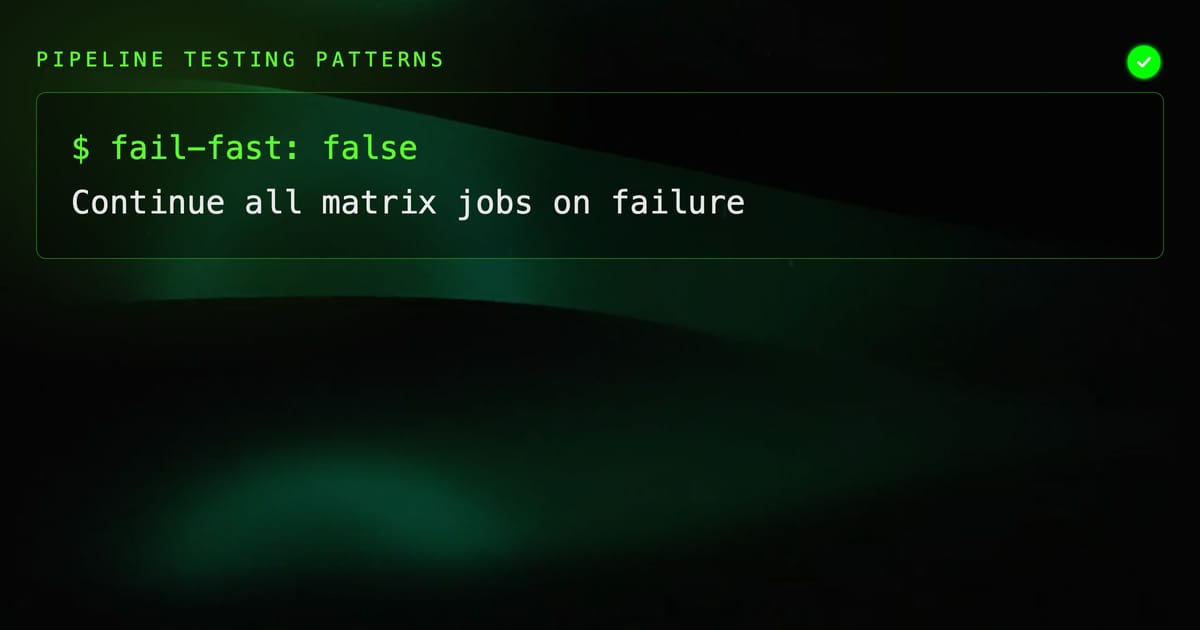
      fail-fast: false  # Don't cancel all jobs if one fails

    steps:
      - uses: actions/checkout@v4
      - uses: actions/setup-node@v4
        with:
          node-version: ${{ matrix.node-version }}
      - run: npm ci
- run: npm testThe fail-fast: false flag is worth thinking about carefully. By default, GitHub Actions cancels all matrix jobs when one fails. That's efficient if you're optimizing for fast feedback, but you lose visibility into which combinations fail. Set it to false when you're diagnosing compatibility issues; leave it at true for routine PR validation.
Caching Dependencies
Test pipelines that reinstall 500MB of dependencies on every run are slow and frustrating. Use caching aggressively:
- name: Cache dependencies
  uses: actions/cache@v4
  with:
    path: |
      ~/.npm
      node_modules
    key: ${{ runner.os }}-node-${{ hashFiles('**/package-lock.json') }}
    restore-keys: |
${{ runner.os }}-node-The hashFiles function creates a cache key based on your lockfile content. When dependencies change, the cache is invalidated automatically. The restore-keys fallback lets you use a partially-matched cache from a previous run if an exact match doesn't exist — this is useful when you've added new packages and the lockfile changed, but most of your existing dependencies are still cached.
Service Containers
Integration tests often need databases or message queues. GitHub Actions supports service containers that run alongside your test job:
jobs:
  integration-tests:
    runs-on: ubuntu-latest
    services:
      postgres:
        image: postgres:16
        env:
          POSTGRES_PASSWORD: testpass
          POSTGRES_DB: testdb
        ports:
          - 5432:5432
        options: >-
          --health-cmd pg_isready
          --health-interval 10s
          --health-timeout 5s
          --health-retries 5

      redis:
        image: redis:7
        ports:
          - 6379:6379
        options: --health-cmd "redis-cli ping" --health-interval 10s

    steps:
      - uses: actions/checkout@v4
      - run: npm ci
      - name: Run integration tests
        run: npm run test:integration
        env:
          DATABASE_URL: postgresql://postgres:testpass@localhost:5432/testdb
REDIS_URL: redis://localhost:6379The health-cmd options are critical. Without them, your tests may start before the database is actually ready to accept connections, causing flaky failures that are hard to diagnose.
GitLab CI
GitLab CI uses a .gitlab-ci.yml file at the repository root. Its stage-based model maps naturally to the testing pipeline concept.
Basic Pipeline Structure
# .gitlab-ci.yml
stages:
  - lint
  - test
  - integration
  - deploy

variables:
  NODE_VERSION: "20"

cache:
  key:
    files:
      - package-lock.json
  paths:
    - node_modules/

lint:
  stage: lint
  image: node:20-alpine
  script:
    - npm ci --cache .npm --prefer-offline
    - npm run lint
    - npm run type-check

unit-tests:
  stage: test
  image: node:20-alpine
  script:
    - npm ci --cache .npm --prefer-offline
    - npm run test:unit -- --coverage --reporter=junit --outputFile=junit.xml
  coverage: '/Lines\s*:\s*(\d+\.?\d*)%/'
  artifacts:
    when: always
    reports:
      junit: junit.xml
    paths:
      - coverage/
expire_in: 1 weekThe coverage field uses a regex to extract the coverage percentage from test output, which GitLab then displays in merge requests. The artifacts.reports.junit configuration uploads test results so GitLab can show individual test failures in the UI rather than forcing you to dig through logs.
Service Dependencies in GitLab CI
integration-tests:
  stage: integration
  image: node:20-alpine
  services:
    - name: postgres:16
      alias: postgres
    - name: redis:7
      alias: redis
  variables:
    POSTGRES_DB: testdb
    POSTGRES_USER: testuser
    POSTGRES_PASSWORD: testpass
    DATABASE_URL: postgresql://testuser:testpass@postgres:5432/testdb
    REDIS_URL: redis://redis:6379
  script:
    - npm ci
    - npm run db:migrate
- npm run test:integrationOne GitLab-specific gotcha: service containers are accessed by their alias, not localhost. If your integration tests are hardcoded to connect to localhost, you'll need to use environment variables for the hostname.
Rules and Conditions
GitLab CI's rules syntax gives you fine-grained control over when jobs run:
e2e-tests:
  stage: integration
  rules:
    - if: '$CI_PIPELINE_SOURCE == "merge_request_event"'
    - if: '$CI_COMMIT_BRANCH == "main"'
  script:
- npm run test:e2eThis runs E2E tests only on merge requests and on the main branch, skipping them for every intermediate feature branch push. That tradeoff — slightly less coverage for individual commits in exchange for faster pipeline feedback — is often worth it when E2E tests take 20+ minutes.
Jenkins
Jenkins is older and more complex than the cloud-native options, but it remains dominant in enterprises. Its Jenkinsfile (Groovy-based) approach gives you the most flexibility at the cost of more verbosity.
Declarative Pipeline
// Jenkinsfile
pipeline {
    agent {
        docker {
            image 'node:20-alpine'
            args '-v /tmp:/tmp'
        }
    }

    options {
        timeout(time: 30, unit: 'MINUTES')
        disableConcurrentBuilds()
        buildDiscarder(logRotator(numToKeepStr: '10'))
    }

    environment {
        NODE_ENV = 'test'
        CI = 'true'
    }

    stages {
        stage('Install') {
            steps {
                sh 'npm ci'
            }
        }

        stage('Lint') {
            steps {
                sh 'npm run lint'
            }
        }

        stage('Unit Tests') {
            steps {
                sh 'npm run test:unit -- --reporter=junit --outputFile=test-results/unit.xml'
            }
            post {
                always {
                    junit 'test-results/unit.xml'
                    publishHTML([
                        reportDir: 'coverage',
                        reportFiles: 'index.html',
                        reportName: 'Coverage Report'
                    ])
                }
            }
        }

        stage('Integration Tests') {
            steps {
                sh '''
                    docker-compose -f docker-compose.test.yml up -d
                    sleep 10  # Wait for services
                    npm run test:integration
                    docker-compose -f docker-compose.test.yml down
                '''
            }
        }
    }

    post {
        failure {
            emailext(
                subject: "Pipeline failed: ${env.JOB_NAME} #${env.BUILD_NUMBER}",
                body: "Check ${env.BUILD_URL}",
                to: "${env.CHANGE_AUTHOR_EMAIL}"
            )
        }
        always {
            cleanWs()
        }
    }
}Parallel Stages in Jenkins
stage('Test') {
    parallel {
        stage('Unit') {
            steps {
                sh 'npm run test:unit'
            }
        }
        stage('Integration') {
            agent {
                docker { image 'node:20-alpine' }
            }
            steps {
                sh 'npm run test:integration'
            }
        }
        stage('Lint') {
            steps {
                sh 'npm run lint'
            }
        }
    }
}The parallel block runs all three stages simultaneously, reducing total pipeline time significantly. Each parallel stage can even use a different agent if needed.
Cross-Platform Patterns That Work Everywhere
Regardless of which platform you use, these patterns consistently improve pipeline test quality:
1. Always publish test artifacts. Store test results, coverage reports, and failure screenshots even when tests pass. When a flaky test appears, you want historical data to diagnose it.
2. Use exit codes correctly. Your test command must exit with a non-zero code on failure. Most test runners do this by default, but check — especially when wrapping commands in shell scripts.
3. Separate fast and slow tests. Unit tests should complete in under 2 minutes. Integration tests in under 10. E2E tests can be longer, but isolate them so they don't block fast feedback for simple changes.
4. Make environment variables explicit. Don't rely on implicit environment inheritance. Declare every variable your tests need in the CI config, even if the value comes from a secret. This makes the pipeline self-documenting.
5. Test the pipeline itself. Use act (for GitHub Actions) or similar local runners to validate pipeline changes before pushing. A broken CI config is just as damaging as broken code.
The investment in solid CI/CD pipeline configuration pays compounding dividends. Every hour spent making your pipeline reliable and fast saves hours of debugging failed deploys and hunting down which commit introduced a regression.