
Agentic Testing Workflows: How AI Agents Run Your Test Suite

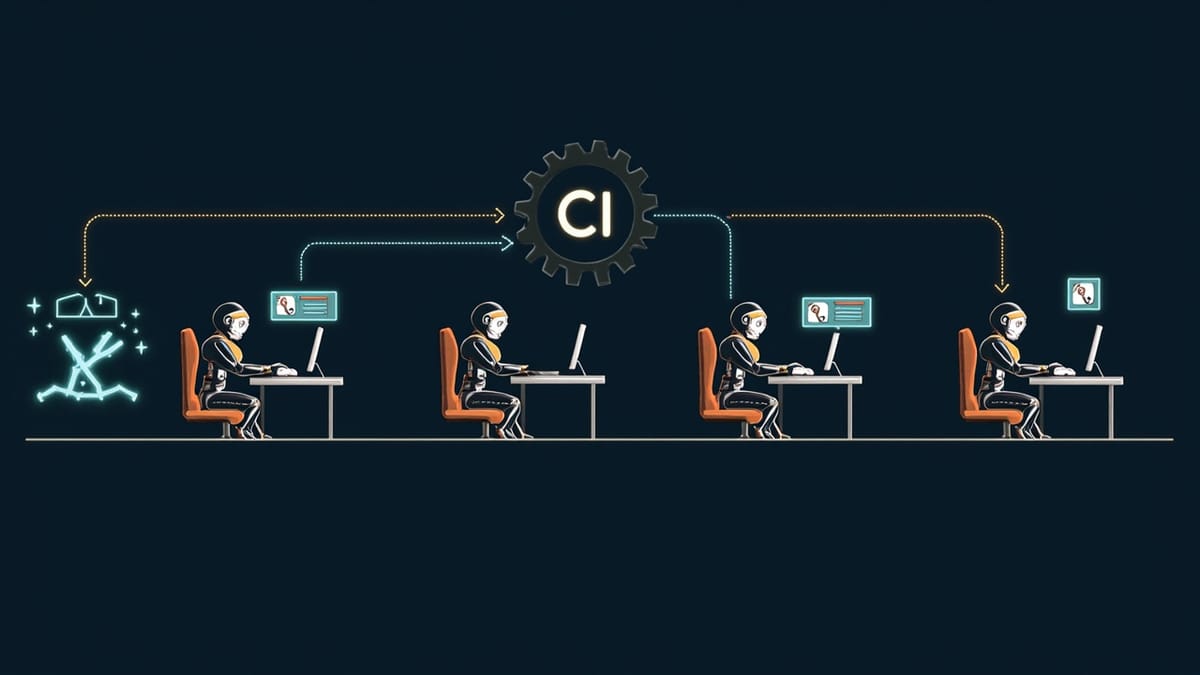
Agentic testing means AI agents that autonomously handle steps in the testing cycle — creating tests, running them, analyzing failures, and fixing issues — without waiting for explicit human instruction at each step. This guide covers the patterns, tools, and implementation approach for teams adopting agentic testing workflows in 2026.
Key Takeaways
Agentic testing is different from test automation. Traditional automation runs tests. Agentic testing decides what tests to run, creates new ones when coverage is missing, and responds to failures intelligently.
MCP integration is the enabling pattern. Model Context Protocol lets AI coding assistants (Claude Code, Cursor) connect to testing platforms directly, giving the agent test creation and execution capabilities in the same context as code development.
Agents need guardrails, not just tools. An agent that can create and delete tests needs clear boundaries. Define what the agent can do autonomously vs. what requires human approval.
Start with a narrow scope. Agentic patterns work best when the agent has a clear mandate — "create tests for any new code in this PR" — not an open-ended task like "make our tests better."
What agentic testing means
Traditional test automation is deterministic: a test script runs, checks conditions, reports pass or fail. Humans write the scripts; automation runs them.
Agentic testing is different. An AI agent:
- Observes — reads code changes, PR diffs, failing tests, coverage reports
- Decides — determines what needs testing based on what changed
- Acts — creates tests, runs them, analyzes results
- Adapts — fixes broken tests, updates coverage, escalates genuine failures
The agent isn't executing a fixed script. It's making decisions based on the current state of the codebase, test suite, and application.
This is a meaningful shift. The bottleneck in traditional automation is human capacity: someone has to write each test, decide what to cover, and maintain tests when they break. Agentic testing delegates those decisions to AI, freeing engineers to focus on what AI can't determine: what matters to test from a business and user perspective.
The enabling technology: MCP
Model Context Protocol (MCP) is the technical foundation for most practical agentic testing implementations in 2026.
MCP gives AI coding assistants (Claude Code, Cursor, GitHub Copilot in agent mode) the ability to connect to external tools — databases, APIs, services — with bidirectional communication. Instead of the AI knowing only what's in the conversation, it can query live systems and take actions.
For testing, an MCP server connected to a testing platform gives the AI agent:
- Test discovery — "what tests exist? which are passing/failing?"
- Test execution — "run these tests and return results"
- Test creation — "create a new test with this specification"
- Failure analysis — "why did this test fail? what changed?"
- Coverage data — "what code paths have no test coverage?"
The result: when an engineer is writing code in Claude Code or Cursor, the AI agent has full context about the testing state. It can proactively create tests for new code, run tests to verify a fix, and report coverage gaps — all within the editor, in the same conversation as the code development work.
Implementing agentic testing with MCP
Here's the pattern for setting up an agentic testing workflow with HelpMeTest:
Step 1: Install the MCP server
# One command installs and configures the MCP server for your editor
helpmetest install mcp --claude HELP-your-token-here   # for Claude Code
helpmetest install mcp --cursor HELP-your-token-here # for CursorAfter this, Claude Code or Cursor can access your HelpMeTest test suite directly.
Step 2: Define the agent's mandate
In a CLAUDE.md or AGENTS.md file in your repo, define what the agent should do:
## Testing Policy

Before closing any feature implementation:
1. Check helpmetest_status() for existing coverage
2. Create tests for any new user flows
3. Run tests and verify they pass
4. Report any failures before considering the feature complete

When a test fails:
- If selector changed: fix the selector, re-run
- If behavior changed intentionally: update the test
- If unexpected regression: escalate to the teamThis gives the agent clear guidelines without requiring explicit instruction on every interaction.
Step 3: Let the agent work proactively
With the MCP server connected and guidelines in place, the agent will:
# Developer in Claude Code: "Add a user profile photo upload feature"

Agent: Implementing the upload endpoint and UI...
[writes code]

Agent: Checking existing test coverage for the profile area...
[calls helpmetest_status()]

Agent: Found 2 existing profile tests, none covering photo upload.
Creating test for the photo upload flow...
[calls helpmetest_upsert_test()]

Agent: Running the new test...
[calls helpmetest_run_test()]

Agent: Test passing. Photo upload works: select file → preview →
save → photo appears on profile page. Feature complete.The agent created and ran the test without explicit instruction — it's part of the workflow, not a separate request.
Agentic CI/CD integration
Beyond the editor, agentic patterns integrate into CI/CD pipelines.
Pattern: PR-triggered test analysis
When a PR is opened, a CI step calls an AI agent to:
- Read the PR diff
- Identify which tests cover the changed code
- Run those tests
- Identify coverage gaps in the changed code
- Create new tests for uncovered paths
- Report results with agent-written explanations
# .github/workflows/agentic-qa.yml
on:
  pull_request:

jobs:
  agentic-qa:
    runs-on: ubuntu-latest
    steps:
      - uses: actions/checkout@v3

      - name: Run HelpMeTest E2E coverage
        run: helpmetest test tag:ci
        env:
          HELPMETEST_API_TOKEN: ${{ secrets.HELPMETEST_API_TOKEN }}

      - name: Report deployment for monitoring
        run: helpmetest health "staging-deploy" "30m"
        env:
HELPMETEST_API_TOKEN: ${{ secrets.HELPMETEST_API_TOKEN }}The agent-mediated portion (gap analysis, test creation) happens in the editor workflow; CI handles execution and result reporting.
Pattern: Failure triage agent
When tests fail in CI, instead of just reporting a failure, an agent analyzes why:
- Is this a flaky test? Check failure history — if it fails intermittently, flag as flaky.
- Did a selector change? Diff the app structure against what the test expects.
- Did behavior change intentionally? Check the PR description and related commits.
- Is this a genuine regression? If none of the above, escalate.
Automated triage reduces the "tests are failing, someone look at it" noise by giving the team actionable context: "test X failed because the login button's class changed from .btn-login to .auth-button. Auto-healed."
Guardrails for agentic testing
Autonomous agents with write access to your test suite need clear boundaries. Without guardrails, agents can:
- Create tests that pass trivially (assert true every time)
- Delete failing tests rather than fix them
- Create redundant tests that inflate coverage numbers without adding value
- Modify test assertions to match incorrect behavior
Define what requires human approval:
| Action | Autonomous OK? |
|---|---|
| Creating new tests for new features | ✅ Yes |
| Running existing tests | ✅ Yes |
| Fixing broken selectors | ✅ Yes (with logging) |
| Updating assertions for intentional behavior changes | ⚠️ Requires approval |
| Deleting tests | ❌ Always human |
| Modifying core test infrastructure | ❌ Always human |
Implement these as explicit policies in your CLAUDE.md or agent configuration files. An agent with clear constraints is more valuable than an unconstrained one — it operates confidently within its boundaries and escalates cleanly when it hits them.
Real-world patterns
Teams using agentic testing in 2026 have settled on a few patterns that work reliably:
The "test as you code" pattern. The agent creates tests for every significant code change, in the same session as writing the code. Tests are never an afterthought because the agent handles them automatically.
The "verify before merge" pattern. Before a PR can merge, the agent must have created tests for new code AND confirmed they pass. This is a policy enforced by the agent, not a checkbox that developers fill out manually.
The "triage before notify" pattern. CI failures go through an agent triage step before paging the on-call engineer. Only genuine regressions generate interrupts; selector churn, flaky tests, and infrastructure noise are handled automatically.
The "coverage debt sprint" pattern. Once a quarter, the agent analyzes the entire test suite, identifies uncovered critical paths, and generates a batch of new tests for human review. Coverage debt gets reduced systematically rather than never.
What agentic testing doesn't solve
Business logic definition. The agent creates tests based on how the code behaves. It doesn't know what the code should do. Tests that verify incorrect behavior — because the code was wrong when the test was generated — will pass forever. Human judgment about what the right behavior is remains necessary.
Exploratory testing. Finding the unexpected — the edge case that nobody anticipated, the interaction between two features that breaks in a non-obvious way — requires human intuition. Agents test what they're pointed at. They don't wander.
User experience. A test can verify that a button exists and is clickable. It can't verify that the page layout makes sense, that the copy is clear, or that the flow is intuitive. UX testing remains a human domain.
Production incidents. Agentic testing during development reduces bugs that reach production. It doesn't eliminate them. Production monitoring (health checks, alerting, observability) is a separate layer that agents can participate in but not replace.
Getting started
The lowest-friction path to agentic testing:
- Install HelpMeTest and the MCP server —
curl -fsSL https://helpmetest.com/install | bash, thenhelpmetest install mcp --claude HELP-your-token - Add a CLAUDE.md testing policy — define that the agent should check coverage and create tests for new features
- Write one feature with the agent — observe how it creates and runs tests automatically; refine the policy based on what works
- Add CI integration — run
helpmetest test tag:cion every PR; add health check heartbeats for deployment tracking - Iterate — as you see what the agent handles well and where it needs guidance, refine your AGENTS.md policies
Agentic testing is a practice that improves with use. The first iteration will be rough; the fifth iteration will feel natural.
HelpMeTest provides the testing platform, CLI, and MCP server for agentic testing workflows. Start a free trial at helpmetest.com — unlimited health checks, usage-based pricing.