
Testing
Testing OpenTelemetry Semantic Conventions Compliance
OpenTelemetry semantic conventions define standard names and attributes for common operations — HTTP requests, database calls, messaging systems, and more.

Testing
OpenTelemetry semantic conventions define standard names and attributes for common operations — HTTP requests, database calls, messaging systems, and more.

Testing
When you add OpenTelemetry instrumentation to your codebase, you're writing code that needs to be tested like any other code.

Testing
Sampling is one of the most consequential decisions in an observability setup — and one of the least tested.
Testing
Your OTEL metrics instrumentation is only as good as your confidence that it measures what it claims to measure.

Testing
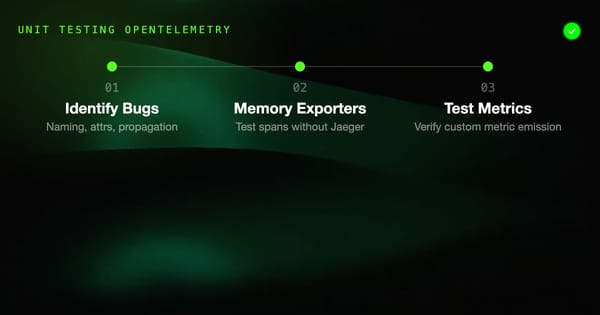
Most teams think of OpenTelemetry as a production concern — you instrument your app, deploy it, and then your observability stack tells you what's happening.
Testing
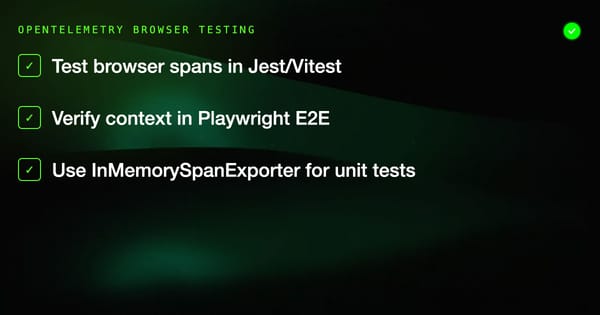
Custom OpenTelemetry instrumentation is code like any other code — it can be wrong, and wrong instrumentation is worse than no instrumentation.
Testing
Browser instrumentation is the hardest part of OpenTelemetry to test. Unlike server-side code, where you can inject an in-memory exporter directly, browser code runs in a JavaScript runtime that has no concept of "injectable test components" at the module level. You need strategies for both unit-
Testing
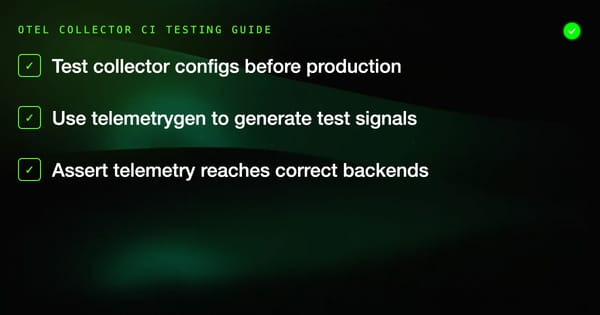
Your OpenTelemetry Collector configuration is infrastructure code. It determines which telemetry reaches which backend, which attributes get stripped or transformed, and what sampling decisions are made. A misconfigured collector silently drops spans, misroutes metrics, or leaks PII in attributes that should have been filtered. The collector should be tested before
Testing
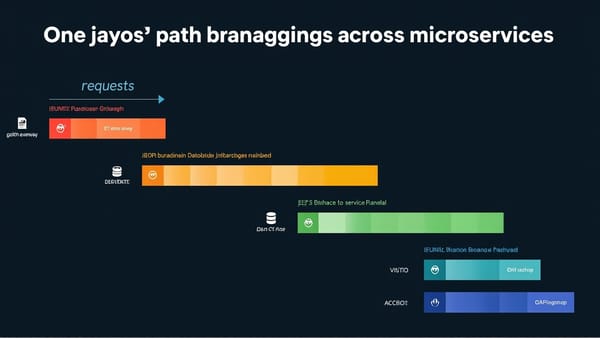
When a microservices integration test fails with a vague 500 error, you have a problem: the error came from somewhere in a chain of four services, passed through an API gateway, and touched a database and a message queue. The stack trace in your test output tells you where the

Testing
OpenTelemetry Collector sits at the heart of modern observability pipelines.

Testing
Tracing tells you what happened — testing tells you whether it should have happened. OpenTelemetry brings them together: instrument once, verify always. What OpenTelemetry Adds to Testing Classic unit and integration tests check return values. They miss latency, span counts, attribute correctness, and propagation across services. OpenTelemetry testing fills that gap

Testing
Playwright tests verify what the user sees. OpenTelemetry traces verify what the backend did to produce it.