Vitest vs Jest: Which Testing Framework Should You Use in 2026?


In 2026, the default answer has changed. If you're starting a new project, Vitest is probably what you want — native ESM, TypeScript out of the box, 3-10x faster in watch mode. If you have 10,000 Jest tests running in CI, don't touch anything.
Key Takeaways
Use Vitest for new projects, Jest for large existing suites. Vitest's native Vite integration eliminates the configuration overhead that makes Jest painful in modern TypeScript projects.
Vitest is 3-10x faster than Jest in watch mode. For developer experience during active development, this difference is the single most compelling reason to switch.
Vitest's Jest-compatible API makes migration incremental. Most Jest tests run in Vitest with import path changes only — you don't have to rewrite your test suite to migrate.
Jest has more mature monorepo and enterprise tooling in 2026. For large organizations with complex setups, Jest's ecosystem depth still outweighs Vitest's speed advantages.
If you are choosing between Vitest and Jest in 2026, here is the short answer: use Vitest for new projects that already use Vite, and stick with Jest if your codebase already runs thousands of Jest tests without issues. Below is the full breakdown — benchmarks, configuration, ecosystem, migration effort — so you can make the right call for your team.
Quick Answer: Vitest or Jest?
| Scenario | Recommendation |
|---|---|
| New Vite/React/Vue/Svelte project | Vitest |
| Existing large Jest test suite (1,000+ tests) | Stay with Jest |
| TypeScript-first codebase | Vitest |
| Need jsdom/happy-dom browser emulation | Either (both support it) |
| Monorepo with mixed bundlers | Jest (more mature monorepo tooling) |
| Want fastest possible test execution | Vitest |
What Is Vitest?
Vitest is a next-generation testing framework built on top of Vite. It was created by Anthony Fu and the Vite team to provide a Jest-compatible testing experience with native ES module support, out-of-the-box TypeScript handling, and significantly faster execution times.
Vitest reached version 1.0 in December 2023 and hit version 3.0 in January 2025, establishing it as a production-ready framework trusted by major open-source projects including Nuxt, SvelteKit, Astro, and Radix UI.
Key characteristics:
- Native ESM support — no Babel transforms needed
- Powered by Vite's dev server for instant hot module replacement (HMR) in watch mode
- Jest-compatible API — most tests migrate with zero changes
- Built-in TypeScript and JSX support without configuration
- In-source testing (write tests inside your source files)
What Is Jest?
Jest is a JavaScript testing framework created by Meta (Facebook) in 2014. It became the default testing tool for React projects and dominated the JavaScript testing ecosystem for nearly a decade. Jest reached version 30 in mid-2025, bringing performance improvements and better ESM support.
Key characteristics:
- Battle-tested across millions of projects
- Massive ecosystem of plugins, reporters, and integrations
- Built-in code coverage, mocking, and snapshot testing
- Strong monorepo support via projects configuration
- Extensive documentation and community knowledge base
Vitest vs Jest: Feature-by-Feature Comparison
Speed and Performance
This is where the vitest vs jest debate gets real. Vitest is consistently faster because it leverages Vite's on-demand transformation pipeline instead of running files through Babel.
| Metric | Vitest | Jest |
|---|---|---|
| Cold start (100 test files) | ~1.2 seconds | ~3.8 seconds |
| Watch mode re-run (single file) | ~50 milliseconds | ~800 milliseconds |
| Full suite (1,000 unit tests) | ~4 seconds | ~12 seconds |
| Parallel execution | Worker threads (default) | Worker threads or child processes |
Benchmarks vary by project size and hardware. These figures reflect typical mid-sized TypeScript/React projects on an M-series Mac.
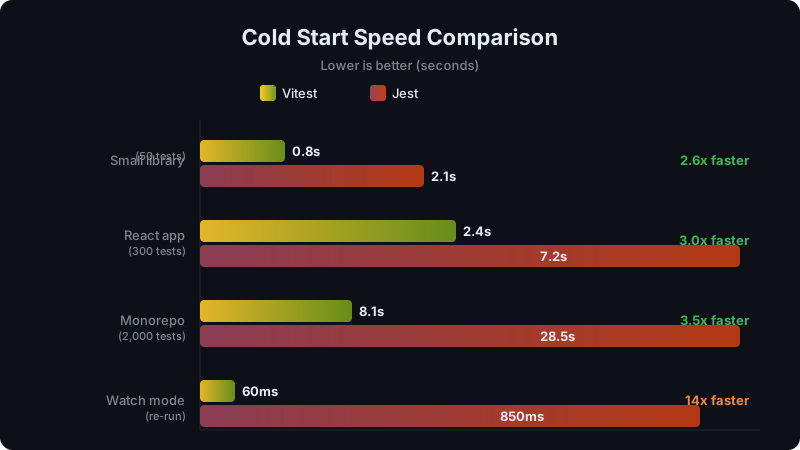
Why is Vitest faster? Three reasons:
- No Babel overhead. Vite uses esbuild for TypeScript and JSX transforms, which is 20-100x faster than Babel.
- Smart watch mode. Vitest only re-runs tests affected by changed files using Vite's module graph, while Jest re-runs based on file-path heuristics.
- Native ESM. No CommonJS interop overhead — modules load as the engine intended.
Configuration
Jest requires explicit configuration for TypeScript, ESM, and path aliases. Vitest inherits your existing vite.config.ts, which means near-zero configuration if you already use Vite.
Jest setup for a TypeScript React project:
// jest.config.js
module.exports = {
  testEnvironment: 'jsdom',
  transform: {
    '^.+\\.tsx?$': ['ts-jest', {
      tsconfig: 'tsconfig.json',
      useESM: true,
    }],
  },
  moduleNameMapper: {
    '^@/(.*)$': '<rootDir>/src/$1',
    '\\.(css|less|scss)$': 'identity-obj-proxy',
  },
  setupFilesAfterSetup: ['./jest.setup.ts'],
  extensionsToTreatAsEsm: ['.ts', '.tsx'],
};Equivalent Vitest setup:
// vite.config.ts (you probably already have this)
import { defineConfig } from 'vitest/config';

export default defineConfig({
  test: {
    environment: 'jsdom',
    setupFiles: ['./vitest.setup.ts'],
  },
  resolve: {
    alias: { '@': '/src' },
  },
});Vitest picks up your path aliases, TypeScript config, and JSX handling from the same Vite config your dev server uses. No duplicate configuration, no ts-jest, no identity-obj-proxy.
TypeScript Support
| Feature | Vitest | Jest |
|---|---|---|
| TypeScript out of the box | Yes | No (needs ts-jest or @swc/jest) |
| Type checking in tests | Via vitest typecheck |
Separate tsc step |
| Config file in TypeScript | Yes (vite.config.ts) | Limited (jest.config.ts with ts-node) |
| Path alias resolution | Automatic from Vite config | Manual moduleNameMapper |
Vitest handles TypeScript natively through esbuild. Jest needs a transform plugin — either ts-jest (slower but accurate) or @swc/jest (faster but occasionally misses edge cases). For TypeScript-first teams, Vitest eliminates an entire category of configuration problems.
API Compatibility
Vitest was designed as a drop-in replacement for Jest. The core APIs are nearly identical:
// This test works in BOTH Vitest and Jest
import { describe, it, expect, vi } from 'vitest'; // or remove import for Jest globals

describe('calculator', () => {
  it('adds two numbers', () => {
    expect(1 + 2).toBe(3);
  });

  it('mocks a function', () => {
    const mockFn = vi.fn(); // jest.fn() in Jest
    mockFn('hello');
    expect(mockFn).toHaveBeenCalledWith('hello');
  });
});The main API differences:
| Jest | Vitest | Notes |
|---|---|---|
jest.fn() |
vi.fn() |
Same behavior, different namespace |
jest.mock() |
vi.mock() |
Vitest hoists automatically |
jest.spyOn() |
vi.spyOn() |
Identical API |
jest.useFakeTimers() |
vi.useFakeTimers() |
Both use @sinonjs/fake-timers |
expect.extend() |
expect.extend() |
Identical |
For most projects, migrating from Jest to Vitest means replacing jest. with vi. and updating config.
Mocking
Both frameworks provide comprehensive mocking, but their approaches differ slightly.
Jest mocking:
// Automatic mock of entire module
jest.mock('./database');

// Manual mock with implementation
jest.mock('./api', () => ({
  fetchUser: jest.fn().mockResolvedValue({ name: 'Alice' }),
}));

// Spy on existing method
const spy = jest.spyOn(console, 'log');Vitest mocking:
// Automatic mock
vi.mock('./database');

// Manual mock — hoisted automatically, no need for factory position
vi.mock('./api', () => ({
  fetchUser: vi.fn().mockResolvedValue({ name: 'Alice' }),
}));

// Spy on existing method
const spy = vi.spyOn(console, 'log');Vitest automatically hoists vi.mock() calls to the top of the file, so you do not need to worry about declaration order. Jest requires jest.mock() at the top level, and mixing it with ESM imports can cause subtle bugs.
Ecosystem and Plugins
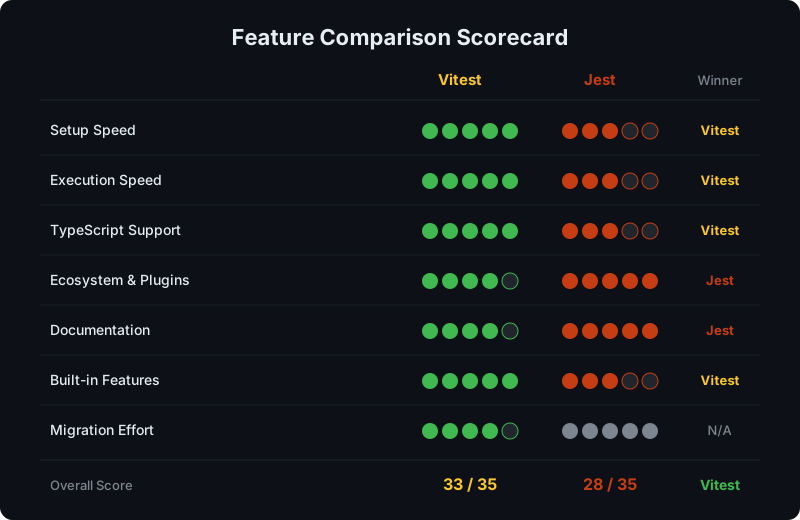
Jest has the larger ecosystem — over 5,000 packages on npm reference Jest in their keywords. Common tools like Testing Library, MSW (Mock Service Worker), and Storybook have first-class Jest integration.
However, Vitest's ecosystem has grown rapidly. As of 2026:
| Tool | Jest Support | Vitest Support |
|---|---|---|
| React Testing Library | Yes | Yes |
| Vue Test Utils | Yes | Yes |
| MSW (Mock Service Worker) | Yes | Yes |
| Storybook | Yes | Yes |
| Playwright Component Testing | No | Yes (experimental) |
| Coverage (Istanbul) | Built-in | Built-in |
| Coverage (v8) | Plugin | Built-in |
| UI Mode (browser dashboard) | No | Built-in (vitest --ui) |
| Benchmarking | No | Built-in (vitest bench) |
| In-source testing | No | Built-in |
Vitest ships with features that require third-party plugins in Jest, including a visual UI dashboard, built-in benchmarking, and in-source testing.
Browser Testing
Vitest 3.0 introduced browser mode powered by Playwright or WebDriverIO, allowing you to run unit tests in real browsers instead of jsdom. This solves a long-standing problem where jsdom does not implement all browser APIs accurately.
// vitest.config.ts
export default defineConfig({
  test: {
    browser: {
      enabled: true,
      provider: 'playwright',
      instances: [
        { browser: 'chromium' },
      ],
    },
  },
});Jest does not have native browser testing. You need a separate tool like Playwright or Cypress for browser-level tests.
When to Choose Vitest
Pick Vitest if:
- You use Vite as your build tool (React, Vue, Svelte, Astro, SolidJS)
- You are starting a new project and want the fastest setup
- TypeScript is your primary language — no config needed
- Watch mode speed matters — Vitest re-runs in milliseconds
- You want built-in UI mode for visual test debugging
- You need browser testing without a separate framework
When to Choose Jest
Pick Jest if:
- You have a large existing Jest suite — migration has a cost, even if small
- Your project uses webpack without Vite — Jest integrates more naturally
- You need a specific Jest plugin that has no Vitest equivalent
- Your team knows Jest well and switching would slow them down
- You run a large monorepo with complex project configurations
How to Migrate from Jest to Vitest
If you decide to switch, the migration is straightforward for most projects:
Step 1: Install Vitest
npm install -D vitestStep 2: Update config
Move your Jest config to vite.config.ts under the test key. Remove ts-jest, babel-jest, and identity-obj-proxy.
Step 3: Replace Jest globals
Use a find-and-replace across your test files:
| Find | Replace |
|---|---|
jest.fn() |
vi.fn() |
jest.mock( |
vi.mock( |
jest.spyOn( |
vi.spyOn( |
jest.useFakeTimers() |
vi.useFakeTimers() |
jest.clearAllMocks() |
vi.clearAllMocks() |
Add import { vi } from 'vitest' to each test file, or enable globals in your config:
export default defineConfig({
  test: {
    globals: true,
  },
});Step 4: Run tests and fix edge cases
npx vitest runMost tests pass immediately. Common issues:
- Timer mocking differences — Vitest uses
@sinonjs/fake-timersby default, which behaves slightly differently than Jest's implementation foradvanceTimersByTime. - Module mocking order — Vitest hoists mocks automatically. If you relied on Jest's specific hoisting behavior with
jest.mock()at non-top-level positions, you may need adjustments. - Snapshot format — Vitest snapshot format is slightly different. Run
npx vitest run --updateto regenerate snapshots.
Vitest vs Jest: Performance Benchmarks by Project Type
| Project Type | Vitest (cold run) | Jest (cold run) | Speedup |
|---|---|---|---|
| Small library (50 tests) | 0.8s | 2.1s | 2.6x |
| React app (300 tests) | 2.4s | 7.2s | 3.0x |
| Full-stack monorepo (2,000 tests) | 8.1s | 28.5s | 3.5x |
| Watch mode re-run | 40-80ms | 500-1,200ms | 10-15x |
The speed advantage compounds in watch mode, where Vitest's Vite-powered module graph means you get near-instant feedback while coding.

Beyond Unit Testing: When Neither Framework Is Enough
Both Vitest and Jest excel at unit and integration testing. But modern applications also need end-to-end tests that verify real user workflows — clicking buttons, filling forms, navigating between pages.
For E2E testing, developers typically add Playwright or Cypress on top of their unit testing framework. That means maintaining two test setups, two configurations, and two mental models.
HelpMeTest takes a different approach entirely: you describe tests in plain English, and an AI agent executes them in a real browser. No test framework configuration, no locator maintenance, no flaky selectors. It works alongside whatever unit testing framework you choose — Vitest, Jest, or anything else.
Frequently Asked Questions
Is Vitest a replacement for Jest?
Vitest is designed as a modern alternative to Jest, not a forced replacement. It offers a compatible API so migration is easy, but Jest remains a solid choice for existing projects. New projects using Vite benefit most from switching to Vitest.
Is Vitest faster than Jest?
Yes. Vitest is typically 2-4x faster for cold runs and 10-15x faster in watch mode. The speed advantage comes from using esbuild instead of Babel for transforms and leveraging Vite's module graph for smart test re-running.
Can I use Vitest without Vite?
Yes. Vitest works standalone without requiring Vite as your build tool. However, you get the most benefit when your project already uses Vite, since Vitest shares the same configuration and transformation pipeline.
Does Vitest support React Testing Library?
Yes. React Testing Library works identically with Vitest. Install @testing-library/react and jsdom, configure the test environment, and your existing Testing Library tests will run without changes.
Should I migrate my existing Jest tests to Vitest?
Only if you are already using Vite or planning to adopt it. If your Jest tests run well and your team is productive, the migration effort may not be justified. If you are experiencing slow test runs or TypeScript configuration pain, Vitest will likely solve those problems.
Does Jest support ES modules?
Jest added experimental ESM support in version 27 and improved it in version 30. However, it still requires configuration flags and does not handle ESM as seamlessly as Vitest, which was built for ESM from the start.
The Verdict
The vitest vs jest comparison in 2026 comes down to your starting point:
- New project with Vite? Choose Vitest. Faster tests, less configuration, better TypeScript experience.
- Existing Jest project working fine? Stay with Jest. Migration has a cost, and Jest is still actively maintained.
- Frustrated with Jest config? Vitest solves most configuration pain points, especially around TypeScript, ESM, and path aliases.
Both are excellent frameworks. The JavaScript testing ecosystem is better for having both of them.