The Testing Pyramid: Unit, Integration, and E2E Tests Explained
The testing pyramid is one of the most widely cited concepts in software engineering — and one of the most frequently misapplied.

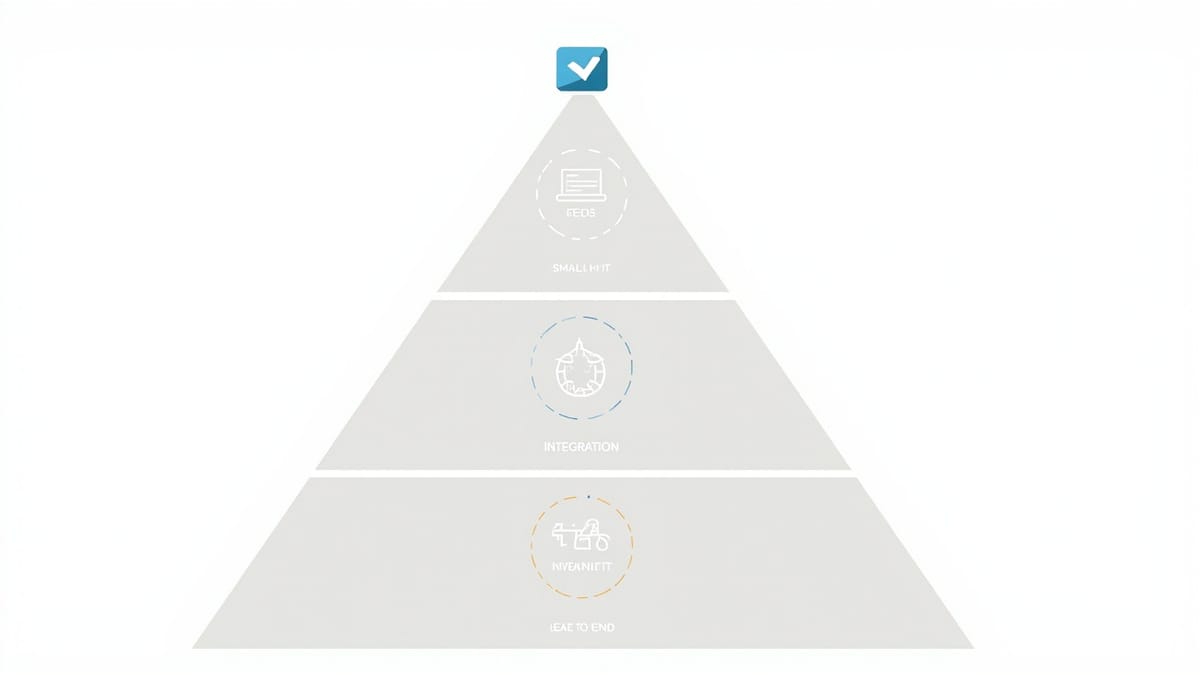
The testing pyramid is a framework for balancing test types: many unit tests at the base, fewer integration tests in the middle, and a small number of E2E tests at the top. This distribution optimizes for speed, reliability, and coverage. Most teams fail by inverting the pyramid — writing too many slow E2E tests and too few fast unit tests.
Key Takeaways
Unit tests are the foundation. Fast, cheap, and highly targeted. Write the most of these — they catch logic errors at the source.
Integration tests validate connections. Services, databases, APIs — these tests confirm that components work together correctly.
E2E tests are expensive but irreplaceable. They test real user flows in a real browser. Write fewer, but make sure you have them for critical paths.
Inverted pyramid = slow, flaky CI. If your test suite takes 30+ minutes and regularly fails for no clear reason, you've probably inverted the pyramid.
E2E tests don't require code. Modern tools like HelpMeTest let you write E2E tests in plain English — removing the main reason teams avoid them.
The testing pyramid is one of the most widely cited concepts in software engineering — and one of the most frequently misapplied. Teams understand it in theory, then build test suites that do the opposite of what it prescribes.
This guide explains the three layers of the testing pyramid, why each layer matters, the cost tradeoffs involved, and the common mistakes that turn a pyramid into an inverted triangle.
What Is the Testing Pyramid?
The testing pyramid — first described by Mike Cohn in Succeeding with Agile — visualizes the ideal distribution of test types in a software project:
        /\
       /  \
      / E2E \
     /________\
    /          \
   / Integration \
  /______________\
 /                \
/   Unit Tests     \
/___________________\The width at each level represents quantity. The position from bottom to top represents cost and complexity.
- Bottom (wide): Unit tests — many of them, cheap, fast
- Middle: Integration tests — fewer, moderate cost and speed
- Top (narrow): E2E tests — fewest, most expensive, slowest
The pyramid shape communicates a specific ratio: roughly 70% unit tests, 20% integration tests, 10% E2E tests. The exact numbers vary by project, but the relative proportions matter.
Unit Tests
What they test: Individual functions, classes, or components in isolation. No external dependencies — databases, APIs, and the filesystem are mocked or stubbed.
Example:
def test_calculate_discount():
    price = 100
    discount_pct = 20
    result = calculate_discount(price, discount_pct)
assert result == 80Characteristics:
| Property | Value |
|---|---|
| Speed | Milliseconds per test |
| Reliability | Very high — no external dependencies |
| Scope | Single function or class |
| Maintenance cost | Low |
| Feedback loop | Immediate |
What they catch:
- Logic errors in individual functions
- Edge cases (null inputs, boundary values, negative numbers)
- Regression when refactoring
What they don't catch:
- Problems between components (API contract mismatches, database query errors)
- Real browser behavior
- Infrastructure issues
When to write them: Any time you write a function with non-trivial logic. For pure utility functions, pure transformations, business logic — unit tests should cover every branch.
The case for many unit tests: They're fast (milliseconds), deterministic (no network or filesystem), and easy to debug (small scope means small blast radius when they fail). A unit test suite with 1,000 tests can run in under 10 seconds.
Integration Tests
What they test: How multiple components interact — a service calling a database, an API endpoint handler invoking multiple internal services, a message queue consumer processing events.
Example:
def test_create_user_writes_to_database():
    response = client.post("/users", json={"email": "test@example.com"})
    assert response.status_code == 201

    user = db.query("SELECT * FROM users WHERE email = 'test@example.com'")
assert user is not NoneCharacteristics:
| Property | Value |
|---|---|
| Speed | Seconds to tens of seconds |
| Reliability | Moderate — depends on external state |
| Scope | Multiple components, real dependencies |
| Maintenance cost | Moderate |
| Feedback loop | Slower than unit, faster than E2E |
What they catch:
- API contract mismatches between services
- Database query errors
- Configuration errors (wrong connection strings, missing env vars)
- Race conditions between components
What they don't catch:
- Real user workflows across the full stack
- UI rendering issues
- Browser compatibility problems
When to write them: For every integration point in your system — anywhere two components talk to each other. APIs that call databases. Services that talk to other services. Message consumers that trigger downstream effects.
Setup complexity: Integration tests require real (or realistic) infrastructure: test databases, test queues, sandboxed external services. This setup cost is why many teams under-invest here — but it's worth it because integration issues are some of the hardest bugs to catch.
End-to-End Tests
What they test: Complete user workflows through the real application, in a real browser or device, against a real (or production-like) backend.
Example:
# Plain English test description
1. Go to the checkout page
2. Add item to cart
3. Enter payment details
4. Click "Complete Purchase"
5. Verify order confirmation page is displayed
6. Verify order appears in order historyCharacteristics:
| Property | Value |
|---|---|
| Speed | Tens of seconds to minutes |
| Reliability | Lower — depends on full stack stability |
| Scope | Full user journey |
| Maintenance cost | High — UI changes break tests |
| Feedback loop | Slow |
What they catch:
- Full user flow failures that unit and integration tests miss
- Frontend-backend integration bugs
- Real browser compatibility issues
- UI rendering problems that affect functionality
What they don't catch:
- Internal logic errors (use unit tests for these)
- Performance issues (use performance testing)
When to write them: For the flows that matter most to users — and to the business. Checkout, login, core feature flows, onboarding. You don't need E2E tests for every edge case — just the paths that, if broken, would cause a P0 incident.
The cost tradeoff: E2E tests are expensive to write (if done in code), slow to run, and brittle to maintain (UI changes break selectors). These costs explain why teams underinvest in E2E coverage — and why they're so critical for the flows that matter most.
Common Mistakes: Inverting the Pyramid
The most common failure mode is the inverted pyramid — or the "ice cream cone" anti-pattern:
/___________\
/ Integration \   (most tests)
/______________\
 /            \
/     Unit     \  (fewest tests)
/_______________\
       /\
      /E2E\       (overwhelming majority)
/______\This happens when teams:
- Rely heavily on manual testing — which gets replaced by E2E when automation begins
- Start with Selenium/Playwright for everything — because E2E tests seem comprehensive
- Never invest in unit testing culture — treating units as optional rather than foundational
- Copy the wrong patterns — seeing E2E-heavy test suites in tutorials and replicating them
Consequences of the inverted pyramid:
- Slow CI: A suite with 500 E2E tests takes hours to run. Teams stop running tests frequently, which defeats the purpose.
- Flakiness: E2E tests fail unpredictably — timing issues, network variability, state leakage between tests. Teams start ignoring failures.
- High maintenance: Every UI change breaks dozens of tests. Maintaining the suite becomes a full-time job.
- False confidence: The suite takes hours and still misses bugs because it doesn't test edge cases (which require unit tests).
The fix: Audit your test distribution. If you have more E2E tests than unit tests, restructure. Move logic out of UI layers so it can be unit tested. Write unit tests for business logic. Reserve E2E tests for the paths where you can't validate behavior any other way.
Cost Tradeoffs: The Real Numbers
Understanding the cost difference at each level helps you make the right tradeoff decisions:
| Test Type | Write Time | Run Time | Maintenance | Debugging Cost |
|---|---|---|---|---|
| Unit | 5–15 min | < 100ms | Very low | Minutes |
| Integration | 30–60 min | 1–30 sec | Moderate | Hours |
| E2E | 1–4 hours (with code) | 30 sec–5 min | High | Hours–days |
A typical E2E test costs roughly 10–20x more than a unit test to write, and 5–10x more to maintain. This is why the pyramid shape makes sense economically: invest heavily in cheap, fast tests; invest selectively in expensive, slow ones.
Applying the Pyramid to Real Projects
For a typical web application:
- Unit tests (70%): Test all service layer logic, utility functions, validation rules, transformers, calculations
- Integration tests (20%): Test API endpoints against a test database, service-to-service communication, external API integrations
- E2E tests (10%): Test login flow, core user journey (for SaaS: the full trial → signup → core feature loop), checkout if you have payments
For an API-only backend:
- Unit tests (60%): Business logic, transformations, validation
- Integration tests (35%): Every endpoint, database interactions, event processing
- E2E tests (5%): Critical workflows via API that span multiple services
For a frontend-heavy app:
- Unit tests (50%): Component logic, hooks, state management, utilities
- Integration tests (30%): Component + API integration, form submission flows
- E2E tests (20%): Full user journeys in the browser (slightly higher than average because frontend risk is higher)
E2E Tests Without Code
The biggest barrier to E2E test coverage is the engineering cost of writing and maintaining test code. Playwright and Selenium require knowing the selectors, handling async operations, dealing with timing issues, and rewriting tests every time the UI changes.
HelpMeTest removes this barrier by letting you write E2E tests in plain English. You describe the user journey — "go to login page, enter email and password, click sign in, verify dashboard appears" — and HelpMeTest generates and runs Robot Framework + Playwright tests automatically.
Self-healing tests mean UI changes don't break your test suite. Continuous monitoring means E2E tests run against production every few minutes, not just in CI. And at $100/month, the cost of E2E coverage is a fraction of what a human QA engineer would cost.
The result: teams that previously skipped E2E coverage (because it was too expensive) can now have comprehensive coverage of their critical user flows.
Summary
The testing pyramid works because it matches test types to what they're good at:
- Unit tests: Fast, reliable, cheap — test logic at the source
- Integration tests: Moderate cost — test that components connect correctly
- E2E tests: Expensive but irreplaceable — test that users can actually accomplish their goals
The ideal distribution is roughly 70/20/10 (unit/integration/E2E). Most teams that struggle with slow, flaky CI have inverted this ratio.
If your test suite is slow, expensive to maintain, or fails too often, audit your distribution. The pyramid shape isn't arbitrary — it reflects the economic and practical reality of software testing at each level.