The Complete Guide to the Test Pyramid: Unit, Integration, and E2E Ratios

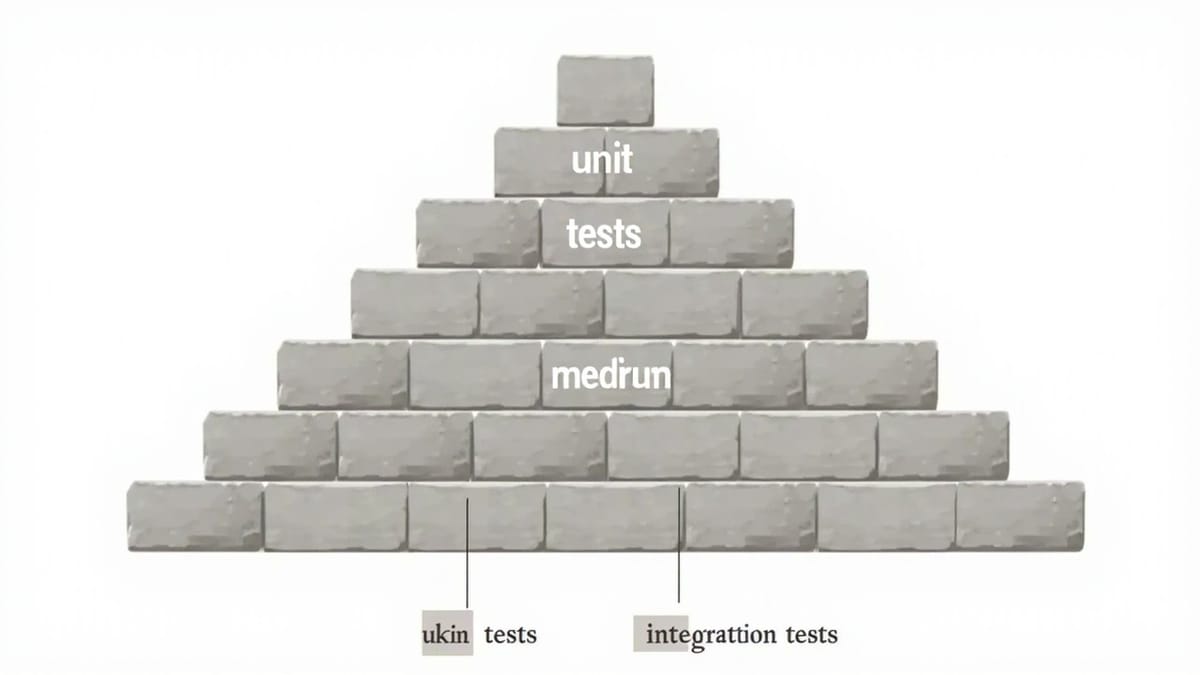
The test pyramid is the most misunderstood model in software testing. Most teams know the shape but not the reasoning behind it — and that leads to costly anti-patterns. This guide explains the original model, why ratios matter, how to adapt them for different architectures, and when it's correct to break the rules.
Key Takeaways
The pyramid is about cost, speed, and confidence — not test count. The ratios encode a tradeoff: cheaper and faster tests at the bottom, more confidence-per-test but higher cost at the top.
Architecture determines the right ratios. Microservices shift the optimal balance toward integration tests; serverless shifts it toward contract tests; monoliths allow more unit test reliance.
The test diamond is the right model for most teams with legacy code. When unit testing is impractical, integration tests carry more weight — that's not a failure, it's a pragmatic adaptation.
Contract testing belongs at the integration layer. It provides service-to-service confidence at a fraction of the cost of E2E tests that verify the same contracts.
Anti-patterns are more costly than missing tests. An inverted pyramid or ice cream cone can waste more engineering time than no automation at all, through slow pipelines and false confidence.
The Original Model and What It Actually Means
Mike Cohn introduced the test pyramid in his 2009 book "Succeeding with Agile." The original model was simple: a triangle with unit tests at the base (most tests), service tests in the middle, and UI tests at the apex (fewest tests). The accompanying recommendation was to invest heavily at the bottom and sparingly at the top.
The model has been adapted, extended, and debated for 15 years. But the core insight remains sound, and it's worth restating precisely: the position in the pyramid is not about test count — it's about cost per test and execution speed.
A unit test costs approximately:
- $0.001–$0.01 in compute per run (milliseconds of CPU)
- 15–60 minutes of developer time to write
- 5–15 minutes of developer time to maintain per change
- Negligible infrastructure cost
An E2E test costs approximately:
- $0.10–$1.00 in compute per run (browser time, full stack)
- 2–8 hours of engineer time to write
- 30–120 minutes of engineer time to maintain per change
- Significant infrastructure cost (browser farm, deployed test environment)
This 100x cost differential is why you want more tests at the bottom and fewer at the top. It's not that E2E tests are bad — it's that each E2E test must justify its cost with confidence that can't be obtained at a lower layer.
Why Ratios Matter
The "right" ratio depends on your codebase, but common guidance from mature engineering organizations is:
- Unit tests: 70–80% of the total test suite
- Integration tests: 15–25%
- E2E tests: 5–10%
A team running 10,000 total tests at these ratios would have approximately 7,500 unit tests, 2,000 integration tests, and 500 E2E tests.
The Practical Implications of Getting Ratios Wrong
Too many E2E tests (inverted pyramid): A team running 60% E2E tests with the same total test count has a suite that takes 5–10x longer to run, costs 5–10x more in infrastructure, and produces 5–10x more maintenance work. Engineering velocity drops. Pipelines slow. Engineers start skipping tests locally because running the suite takes 40 minutes.
Too few integration tests: The unit layer verifies individual functions; the E2E layer verifies user journeys. The gap between them — service interactions, database queries, message queue consumption, external API calls — goes untested. This is where many production bugs live. Teams that skip integration tests often discover this during incidents.
Too few E2E tests (over-correction): In response to slow, flaky E2E suites, some teams delete all E2E tests and rely entirely on unit and integration tests. This can work, but it requires extremely disciplined contract testing and integration coverage. Most teams lack that discipline, and the result is production bugs that no test caught because the integration between components was never verified end-to-end.
Adjusting Ratios by Architecture
The default pyramid ratios assume a traditional layered application with clear unit boundaries. Different architectures require different ratio adjustments.
Microservices Architecture
In a microservices system, "unit testing" is ambiguous — a service is itself a unit. Unit tests within a service verify individual functions; integration tests verify the service as a deployable unit with its dependencies; E2E tests verify flows across multiple services.
Recommended adjustment: Shift weight toward integration tests. The most valuable tests in a microservices architecture are service-level integration tests — tests that deploy the service with its real dependencies (database, message queue) and verify its behavior from the API boundary inward. These tests catch the integration bugs that pure unit tests miss while being 10–20x faster than full E2E tests.
A reasonable ratio for microservices:
- Unit tests: 50–60% (verify business logic within services)
- Integration tests: 30–40% (verify each service as a deployable unit)
- E2E tests: 5–10% (verify critical cross-service user journeys)
- Contract tests: tracked separately (verify service-to-service contracts)
Contract testing becomes essential. When you have 20 services with complex inter-service dependencies, E2E tests that verify those dependencies are expensive and slow. Consumer-driven contract tests verify that each service honors the contracts expected by its consumers, providing service-to-service confidence at integration test speed.
Monolithic Architecture
A well-structured monolith with clear module boundaries is actually the best environment for the original pyramid ratios. Unit tests can verify individual modules in isolation; integration tests can verify module interactions within the monolith without spinning up separate services; E2E tests verify user journeys through the full application.
Recommended adjustment: The original pyramid ratios (70/20/10) work well. If the monolith has good dependency injection and testable interfaces, invest heavily in unit tests. If it's a poorly structured monolith (tightly coupled, minimal interfaces), the unit test layer is harder to build and integration tests carry more weight.
The risk in monolithic architectures is the module boundary problem: because everything is in one process, it's tempting to test module interactions at the E2E layer rather than writing integration tests at the module boundary. Resist this — module-level integration tests are much faster and more specific than browser-based E2E tests.
Serverless Architecture
Serverless introduces unique testing challenges. Individual functions are easy to unit test. But the orchestration — event triggers, IAM permissions, cross-function data flow, service integrations — is difficult to test at any layer below E2E.
Recommended adjustment: Reduce unit test proportion (serverless functions are often small and logic-light), increase integration testing of individual functions with their real AWS/GCP/Azure dependencies, and accept a higher proportion of E2E tests for verifying orchestration.
Tools like LocalStack (AWS), the Functions Framework (GCP), and Azure Functions Core Tools enable local integration testing of serverless functions with their cloud dependencies — use them aggressively to keep orchestration tests out of the E2E layer.
Recommended ratio for serverless:
- Unit tests: 40–50% (business logic within functions)
- Integration tests: 35–45% (function + cloud service integration)
- E2E tests: 10–15% (end-to-end flow verification)
Event-Driven Architecture
Systems built on event streaming (Kafka, Kinesis, SNS/SQS) have a specific testing challenge: the asynchronous, temporal decoupling between producers and consumers makes integration testing complex. A unit test can verify that a producer emits the right event; a consumer-side unit test can verify that a consumer handles an event correctly. But whether the producer and consumer agree on the event schema is a contract problem that requires a different approach.
Recommended adjustment: Invest heavily in producer-consumer contract tests at the integration layer. Use tools that serialize the contract (AsyncAPI, Pact for async protocols) and verify both sides independently. This eliminates the need for expensive E2E tests that wait for events to propagate through the full system.
The Test Diamond: Adapting for Legacy Code
The test pyramid assumes you can write unit tests at will. Legacy codebases often don't allow this — tightly coupled code, global state, singletons, and framework dependencies make unit testing impractical without significant refactoring.
In this context, the test pyramid becomes the test diamond:
         /\
        /E2E\
       /------\
      /        \
     / Integration \
    /--------------\
     \   Unit   /
\---------/Integration tests become the widest layer because they can test the system's behavior without requiring the code to be architecturally clean. You don't need to inject dependencies to test a legacy module at the HTTP boundary — you call it through its real interface and assert the output.
The diamond is not a failure state. For teams maintaining legacy systems while shipping features, the diamond is the right pragmatic adaptation. Fighting the codebase to write unit tests for everything will cost more than the unit tests are worth. Start with integration tests that provide broad coverage, then refactor toward unit testability incrementally.
Transitioning from diamond back to pyramid: As you refactor legacy code, extract clean interfaces, and introduce dependency injection, unit tests become practical. Track your unit/integration ratio over time — a ratio moving toward pyramid shape indicates architectural improvement. The ratio itself becomes a leading indicator of code quality.
Contract Testing in the Pyramid
Contract testing deserves its own discussion because it doesn't fit cleanly into any traditional pyramid layer.
Consumer-driven contract testing (CDCT), popularized by Pact, works like this: each consumer of an API or event stream defines a contract — the requests it makes and the responses it expects. The provider is then independently verified against those contracts. No shared environment required. No deployed stack required. Tests run in isolation.
Where it lives: Contract tests run at integration test speed but verify what would otherwise require E2E tests to validate. Conceptually, they live between integration and E2E — they verify service-to-service compatibility without the full deployment cost.
When to use it: Contract testing is most valuable when you have multiple services with independent deployment cycles. If Service A and Service B deploy independently, you need a mechanism other than shared E2E tests to verify that their interfaces remain compatible. Contract testing is that mechanism.
When it's not worth the investment: Contract testing has significant setup overhead. For small teams with two or three services, carefully maintained integration tests against real service instances are often simpler and cheaper than implementing full CDCT infrastructure. The investment pays off when you have 5+ services with complex inter-service dependencies.
When to Break the Pyramid Rules
The pyramid is a heuristic, not a law. There are legitimate situations where the right answer deviates from the standard ratios.
High UI Complexity, Low Business Logic
Consumer-facing products with complex user interaction patterns (drag-and-drop interfaces, rich text editors, real-time collaboration) may legitimately need more E2E and visual regression tests than a simple pyramid would suggest. If the core complexity is in the user interface, unit tests of business logic don't catch the bugs users experience. In this case, a heavier E2E proportion is justified.
Regulatory Requirements for End-to-End Traceability
Some compliance frameworks require documented evidence that specific user flows pass specific regulatory requirements — end-to-end, not just at the unit level. Medical device software under FDA guidance, financial systems under PCI-DSS, and healthcare applications under HIPAA often need E2E test artifacts as compliance evidence. In these contexts, maintaining a larger E2E suite than the pyramid suggests is a regulatory requirement, not a choice.
Low-Code and Configuration-Heavy Systems
Systems where most of the logic is in configuration (infrastructure-as-code, CMS-driven applications, no-code platforms) have very little unit-testable code. The complexity lives in the interactions between configured components — which is integration or E2E territory. Forcing a pyramid shape on a configuration-driven system is artificial.
Anti-Patterns and Their Costs
The Inverted Pyramid
More E2E tests than unit tests. This is the most common anti-pattern in teams that started testing with Selenium or Cypress and never developed a strong unit testing culture.
Symptom: Pipeline takes 45+ minutes. Any infrastructure issue (browser, environment, network) causes widespread test failures. New team members spend their first week learning the E2E framework rather than writing business logic tests.
Cost: Assuming an industry-average flaky test rate of 10% in a large E2E suite, a team running 2,000 E2E tests can expect 200 false failures per run. If each false failure takes 10 minutes to investigate and dismiss, that's 33 engineer-hours per day spent managing flakiness.
Correction: Freeze E2E test additions. For each new feature, require that unit and integration tests be written first. Allow E2E tests only for critical paths that can't be covered at a lower layer. Over 12–18 months, the ratio normalizes.
The Ice Cream Cone
A variation of the inverted pyramid, the ice cream cone adds a bulge at the top from manual testing on top of E2E automation. The largest investment is in manual testing; automated E2E is second; unit tests are the smallest layer.
Symptom: Manual QA is a bottleneck before every release. Release frequency is weekly or less because the manual regression cycle takes days. When manual QA resources are unavailable (vacation, illness, hiring lag), releases stop.
Cost: Beyond the direct cost of manual testing time, the ice cream cone creates a quality culture problem. Engineers learn that testing is something that happens to code after it's written, rather than a development activity. Test automation investment stalls because "QA handles that."
Correction: This requires cultural change, not just tooling. Engineers must own unit and integration testing as part of feature development. Manual testing should be reserved for exploratory testing and edge cases, not regression. The transition typically takes 18–24 months.
The Honeycomb (Over-Investment in Integration Tests)
Some microservices teams, reacting against poor unit test culture, invest almost entirely in integration tests. Each service has 500 integration tests and 50 unit tests. The result: integration tests are slow to run, require complex setup and teardown, and are difficult to debug when they fail.
Correction: Identify the pure business logic within each service — input validation, calculation, transformation, classification — and write unit tests for it. Reserve integration tests for the service's interactions with its dependencies. A well-balanced service might have 200 unit tests and 50 integration tests, not the reverse.
Calculating Your Team's Optimal Ratio
There is no universal ratio. Here is a decision framework for calculating yours:
Step 1: Assess architectural testability. How easily can you write unit tests today? If the answer is "easily, with good dependency injection," the pyramid ratios apply. If "with significant effort," shift weight toward integration. If "practically impossible without rewriting," you're in diamond territory.
Step 2: Map your risk profile. Where do your production bugs actually come from? Analyze your last 20 production incidents by layer: bugs in business logic (unit test territory), bugs in service integration (integration test territory), bugs in user flow orchestration (E2E territory). Invest proportionally in where bugs actually live.
Step 3: Measure your current cost per test. Time to write, time to maintain (average per change), compute cost per run, flaky failure rate. If your E2E tests have a 20% flaky rate and take 5 hours to write each, they're extremely expensive relative to their confidence value.
Step 4: Set a target ratio and track toward it. Define the ratio you're aiming for based on steps 1–3. Track your current ratio monthly. Use it as a leading indicator of automation health — deviations from target should trigger discussion about why the ratio is changing.
The pyramid is a compass, not a destination. The discipline of measuring your actual ratio, comparing it to your target, and understanding the gap is more valuable than hitting any specific number.