
Test Automation Strategy for Large-Scale Teams: ROI, Toolchain, and Org Structure

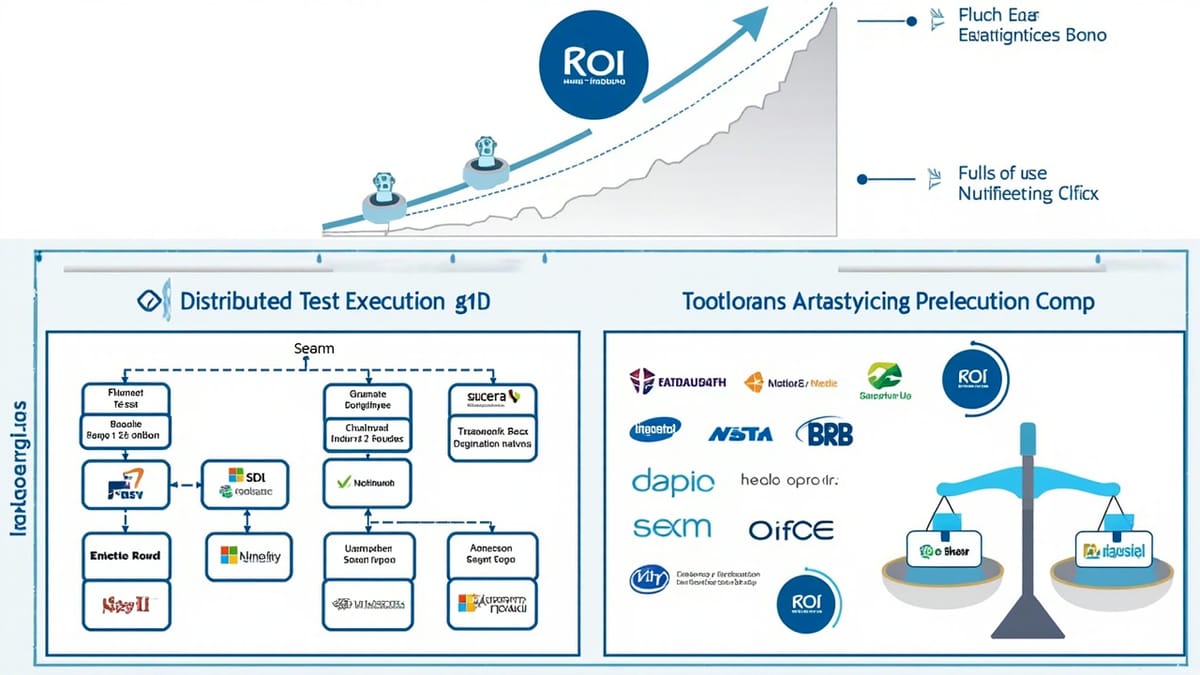
Scaling test automation beyond 50 engineers requires more than adding tools — it demands deliberate decisions about ROI measurement, toolchain architecture, distributed execution, and ownership models. This guide walks senior QA leaders through the frameworks that separate high-performing automation programs from expensive, slow, maintenance-heavy ones.
Key Takeaways
ROI must be quantified before toolchain decisions. Time saved, defect escape reduction, and deployment frequency improvement are the three levers that justify automation investment at scale.
Toolchain choices ripple through the entire org. The right tool at the wrong layer (e.g., E2E tests covering unit-testable logic) destroys ROI faster than no automation at all.
Distributed execution is not optional at scale. A 45-minute test suite blocks deployment pipelines regardless of how well the tests are written.
Ownership models determine long-term maintainability. Embedded QA and central platform teams each have failure modes — the hybrid model is usually the right answer.
Flaky test rate is the leading indicator of automation health. Track it weekly, treat it like a P1 incident when it exceeds 5%, and build systematic elimination into your team's normal workflow.
Why Most Automation Programs Stall After 50 Engineers
The pattern is predictable. A team invests six to twelve months building a solid automation suite. Test coverage climbs, confidence grows, and engineers start shipping faster. Then the org crosses the 50-engineer threshold. Suddenly the suite takes 40 minutes to run. Flaky tests appear at a rate faster than anyone can fix them. Three different teams have adopted three different frameworks. The platform team is drowning in framework support tickets while product engineers blame QA for slow pipelines.
The root cause is almost never technical. It's structural. Automation programs that work at 10 engineers break at 50 because the underlying decisions — about ROI measurement, toolchain governance, execution infrastructure, and ownership — were never made explicitly. They were made by default, one local decision at a time.
This guide is for the QA leader or engineering manager who has inherited this situation, or wants to prevent it before it happens.
Building the ROI Calculation Framework
Before making any toolchain or org structure decisions, you need numbers. "Automation is valuable" is not a budget argument. These three metrics are.
Time Saved Per Release Cycle
Start with the counterfactual: how long would manual regression take if the current automated suite didn't exist? For each automated test, estimate the manual execution time (typically 2–5 minutes per test case including setup and teardown). Multiply by release frequency.
A team running 2,000 automated tests at 3 minutes each saves 100 hours of manual testing per release cycle. At 2 releases per week across 50 weeks, that's 10,000 engineer-hours saved annually. At a fully-loaded cost of $120/hour, that's $1.2M in avoided manual testing cost — before you count defect detection.
This calculation should be revisited quarterly. As automation coverage grows, the saved time grows. As the suite gets slower or flakier, the actual realized savings shrink.
Defect Escape Rate Reduction
Track defects found in production versus defects found pre-production, segmented by whether the area had automated coverage. Teams with mature automation programs typically see production defect rates 40–70% lower in covered areas versus uncovered ones.
The business case: a production incident costs 5–20x more to fix than a pre-production defect, factoring in customer impact, on-call response, hotfix deployment, and incident review. If your automation program prevents 50 production incidents per year at an average cost of $15,000 each, that's $750,000 in avoided incident cost.
Present this to engineering leadership as a risk-adjusted ROI: you're paying X per year for automation infrastructure and SDET time, and getting Y in prevented incidents plus Z in avoided manual testing. X should be less than Y + Z.
Deployment Frequency Improvement
Automated test suites enable continuous delivery. Teams without automation gate deployment on manual regression windows — typically 2–5 days per release. Teams with fast, reliable automation deploy on-demand.
Measure this before and after automation investment: how many deployments per week, and what's the cycle time from code-complete to production? A 3x improvement in deployment frequency (from weekly to daily, for example) has documented revenue impact through faster feature delivery and faster incident resolution.
Toolchain Selection by Layer
The test pyramid exists because different test types have different cost/speed/confidence tradeoffs. Getting the toolchain right at each layer is how you avoid the automation tax of maintaining expensive, slow tests for things that should be cheap and fast.
Unit Test Layer: Optimize for Developer Velocity
Unit tests should be written and maintained by the developers who wrote the code. The QA team's role here is governance, not authorship. Your toolchain decisions:
Language-native frameworks first. Jest for JavaScript, pytest for Python, JUnit/TestNG for Java, RSpec for Ruby. Don't introduce a second framework for unit testing unless there's a compelling reason — the overhead of maintaining two frameworks at scale is rarely worth it.
Coverage thresholds as quality gates. Set minimum coverage requirements at the module level (not the project level). A 70% project-wide average hides 10 modules at 100% coverage and 5 modules at 0%. Gate pull request merges on coverage deltas: a PR that drops coverage by more than 2% in the changed files requires explicit approval.
Mutation testing for critical paths. Tools like PIT (Java) and Stryker (JavaScript/TypeScript) verify that your tests actually catch bugs, not just execute code. Apply mutation testing to your most business-critical modules — payment processing, auth, data pipelines — and track mutation score quarterly.
Integration Test Layer: The Highest ROI Investment
Integration tests — covering service-to-service communication, database interactions, and external API contracts — provide the best balance of coverage, speed, and cost at scale. They're slower than unit tests but 10x faster than E2E tests, and they catch the bugs that unit tests miss: database constraint violations, API contract mismatches, message queue serialization errors.
Toolchain patterns that work at scale:
For REST APIs: language-native HTTP clients with testcontainers for database dependencies. Testcontainers spins up real database instances in Docker, eliminating the shared database environment problem that causes flaky integration tests in large teams.
For message-driven architectures: embedded broker instances (embedded Kafka, embedded RabbitMQ) for fast integration tests, plus contract tests against real broker instances in CI.
For microservices: Pact or another consumer-driven contract testing tool. Contract tests belong at the integration layer, not E2E — they're faster, more specific, and don't require the full deployment stack.
Test data management is the hard problem at this layer. Each integration test should manage its own data setup and teardown. Shared test databases with shared seed data are the primary source of integration test flakiness at scale. Invest in database-per-test-run patterns early.
E2E Test Layer: Ruthless Prioritization
E2E tests are expensive. They're slow to write, slow to run, slow to debug, and expensive to maintain. At scale, an E2E suite that covers everything will destroy your deployment pipeline.
The rule of thumb: E2E tests should cover user journeys that cannot be verified at a lower layer. If a test can be written as an integration test or a unit test, it should be. If the test requires a browser, a full deployment stack, and end-to-end data flow to verify something meaningful, then it belongs in the E2E layer.
Toolchain selection criteria for E2E:
Playwright has become the standard for web E2E testing in large teams. Its built-in parallelization, browser-pool management, and trace recording capabilities make it operationally superior to Selenium at scale. Cypress remains viable for teams already invested in it, but its single-browser-per-worker model makes it harder to scale.
For API E2E testing (end-to-end flows through microservices without a browser), language-native HTTP clients with a well-designed test harness outperform heavyweight BDD frameworks. Reserve Cucumber and SpecFlow for cases where business stakeholders genuinely co-author test scenarios — which is rarer than vendors suggest.
Distributed Test Execution
A test suite that takes 45 minutes to complete is not a fast-feedback mechanism. It's a queue that engineers learn to bypass. Distributed execution is not an optimization for large teams — it's a baseline requirement.
Sharding Strategies
File-based sharding splits test files across parallel workers. It's simple to implement and works well when test files are roughly equal in execution time. Most CI systems (GitHub Actions, CircleCI, GitLab CI) support matrix strategies that implement file-based sharding natively.
Time-based sharding distributes tests based on historical execution time, balancing worker load more precisely than file counts. Playwright's built-in sharding uses a hash-based approach; tools like Knapsack Pro and Currents provide historical-time-based distribution for Cypress and other frameworks.
Test impact analysis runs only the tests affected by changed code. This is the highest-ROI optimization for large suites. By analyzing code coverage data and dependency graphs, you can reduce the test set run per PR from 100% to 10–30% while maintaining the same defect detection rate for the changed code. Bazel and Buck implement this natively; Jest has built-in support for affected-tests mode.
Infrastructure Patterns
For teams under 100 engineers, managed CI/CD infrastructure (GitHub Actions, GitLab CI) with generous parallelism limits is usually sufficient. Configure matrix jobs to shard your E2E suite across 10–20 workers.
For teams above 100 engineers with large E2E suites, consider dedicated browser farm infrastructure. Selenium Grid, Playwright's browser server mode, and managed services all provide browser pools that decouple test execution from CI machine capacity.
The goal is a test pipeline where PR feedback arrives within 15 minutes, and full regression completes within 30 minutes. If you're beyond those thresholds, prioritize execution speed before adding more tests.
Ownership Models and Org Structure
This is where most large-scale automation programs fail. The toolchain is usually not the problem. The ownership model is.
Embedded QA Model
Every product team has dedicated QA engineers who own that team's test suite. The QA engineers sit in team standups, participate in sprint planning, and are responsible for test coverage for their team's features.
Strengths: Deep domain knowledge, fast feedback loops, tests that reflect actual user behavior, no bottleneck through a central team.
Failure modes: Inconsistent standards across teams, duplicate frameworks, no one owns cross-cutting infrastructure, SDET skillsets vary wildly, embedded QA engineers get pulled into manual testing when deadlines approach.
When it works: Product-led organizations with 3–8 member teams, high autonomy culture, and a strong guild or community of practice to maintain standards.
Central Platform Team Model
A dedicated QA platform team owns all test infrastructure, frameworks, shared tooling, and standards. Product engineers write tests using the platform team's tools, and the platform team provides support and onboarding.
Strengths: Consistent toolchain, shared infrastructure investment, specialist expertise, clear ownership of test reliability.
Failure modes: Platform team becomes a bottleneck, product engineers feel disconnected from quality ownership, platform team priorities diverge from product team needs, support ticket queue grows faster than the team can handle.
When it works: Large organizations (200+ engineers) with a dedicated engineering productivity function, regulatory environments requiring consistent audit trails, or organizations undergoing consolidation from many disparate systems.
Hybrid Model (Recommended at Scale)
A small central platform team (3–6 engineers) owns shared infrastructure, toolchain standards, and the most critical E2E smoke suites. Embedded QA engineers in product teams own feature-level automation, operating within the standards and toolchain provided by the platform team.
The platform team's charter is explicit: reduce the cost of writing and maintaining tests, not own testing. They build and maintain the test harness, shared fixtures, CI/CD integration, flaky test detection infrastructure, and coverage reporting. Product teams own everything else.
This model scales to 500+ engineers when the platform team's interfaces are well-designed: clear APIs for common test setup patterns, good documentation, and fast support SLAs.
Anti-Patterns to Avoid
The Automation Pyramid Inversion
When E2E tests are easier to write than unit tests (often because the system under test is hard to unit-test), teams naturally write more E2E tests. Over time, the pyramid inverts: thousands of slow E2E tests, minimal unit tests. The result is a suite that takes hours to run and requires dedicated infrastructure to maintain.
Detection: if your E2E suite takes longer to run than your unit + integration suite combined, you have an inverted pyramid. Correction: invest in making lower-level tests easier to write (better dependency injection, testcontainers, more modular architecture) before adding more E2E tests.
The Coverage Illusion
High code coverage with low-quality tests. Tests that assert assertNotNull(result) or check that a method was called without verifying the output. Teams game coverage metrics by writing tests that execute code without asserting meaningful behavior.
Detection: run your test suite and delete 20% of assertions at random. If your test pass rate doesn't change significantly, your tests aren't asserting much. Correction: shift coverage metrics toward behavior coverage (are the important behaviors verified?) rather than line coverage.
Framework Proliferation
At 50+ engineers without strong governance, teams independently adopt different frameworks. Within a year, you have Jest, Vitest, Mocha, and Jasmine for JavaScript unit tests; Cypress, Playwright, and WebdriverIO for E2E. The overhead of maintaining expertise across all these frameworks, writing shared tooling that works with each, and debugging failures across different environments is enormous.
Detection: inventory your current frameworks across all teams. If you have more than 2 frameworks per test layer, you have proliferation. Correction: migration costs are real — don't underestimate them — but the long-term maintenance cost of proliferation is higher. Pick standards, build migration guides, and give teams a 2-quarter runway to converge.
Metrics to Track Weekly
Flaky test rate: Percentage of test runs that fail intermittently (pass when re-run without code changes). Target: below 2%. Alert threshold: above 5%. A flaky test rate above 5% means engineers have learned to ignore test failures, which means your suite is providing false confidence.
Suite execution time (P95): The 95th percentile execution time for your full test suite. This is more meaningful than average because it captures the tail — the slow runs that block deployment. Target: under 15 minutes for unit + integration, under 30 minutes for full regression.
Coverage delta per sprint: The change in coverage percentage, not the absolute number. A team maintaining 80% coverage while adding features is doing better than a team that has grown to 85% but stopped adding new features months ago.
Mean time to repair (MTTR) for broken tests: How long does a broken test stay broken before it's fixed or deleted? Target: under 24 hours. A test that's been broken for a week has already provided zero value for a week and has potentially caused engineers to suppress failure notifications.
Defect escape rate by coverage tier: Track production defects by whether the affected code area had automated coverage. This is the ultimate validation of your automation program's effectiveness, and the data that makes the ROI case to leadership.
The 90-Day Automation Health Audit
If you've inherited a large-scale automation program or are taking over a team with automation debt, run this audit in your first 90 days.
Days 1–30: Inventory. Count tests by layer, measure execution time by layer, identify flaky tests, map toolchain usage across teams, interview 5–10 engineers about their daily experience with the test suite.
Days 31–60: Triage. Rank problems by impact: flaky tests affecting pipeline reliability, slow suites blocking deployment, missing coverage in high-risk areas, framework proliferation increasing maintenance cost. Identify the two or three changes that will have the highest ROI.
Days 61–90: Repair and baseline. Execute the highest-priority fixes, establish the weekly metrics dashboard, run the first test debt sprint (see the companion post on managing test suite technical debt), and present findings and roadmap to engineering leadership.
The output of this audit is a concrete automation roadmap with quantified ROI for each initiative — the foundation for building a sustainable, scalable automation program.