Ranorex Studio Features: Complete Guide to Enterprise GUI Test Automation

Ranorex Studio is a commercial test automation framework built for teams that need to automate desktop, web, and mobile applications without writing everything from scratch. It ships with a GUI recorder, a full IDE, and a library of pre-built test automation components — all targeting the QA engineer who needs results faster than a code-first approach allows.
This guide covers the core features, where Ranorex genuinely helps, and where you'll hit walls.
The Object Spy and Repository
The foundation of Ranorex is its object recognition engine. The RanoreX Spy inspects the application under test and captures UI elements as objects with technology-specific attributes:
- Win32/WPF/WinForms — uses Windows accessibility APIs (MSAA, UIA) to identify controls by name, class, or automation ID
- Web (Chromium, Firefox, IE) — DOM-based identification using tag, id, class, and custom attributes
- Mobile — iOS UIAutomation and Android UIAutomator bridges via the Ranorex Mobile WebDriver
Captured elements go into the Repository — a centralized XML file that maps friendly names to element paths. Tests reference repository items by name, not raw XPath or CSS selectors. When the UI changes, you update the repository once and all tests that reference that item inherit the fix.
<!-- Repository entry example -->
<element name="LoginButton" path="//button[@id='login-btn']" technology="Web" />This approach trades flexibility for maintainability. It works well for stable enterprise UIs; it adds friction when the UI is in heavy flux.
Recording and Playback
Ranorex ships with a codeless recorder that captures interactions as you click through the application. The recorder produces action sequences in the Ranorex test format, which you can edit in the GUI or extend with C# code.
What the recorder captures:
- Mouse clicks and keyboard input
- Dropdown selections and checkbox toggles
- Drag-and-drop operations
- Validation checkpoints (element exists, text matches, image matches)
The recording output is not raw script — it's a structured action list tied to repository items. This means a recorded test is immediately editable: reorder steps, add loops, inject variables, or swap out repository items.
Limitation: Complex interactions — custom HTML5 controls, canvas elements, WebGL — often don't record cleanly. You'll need to drop into the C# API for those.
Test Suite Structure
Tests in Ranorex are organized hierarchically:
- Test Suite → the root container for a test run
- Test Case → a named test covering one scenario
- Test Module → a reusable action sequence (analogous to a page object)
- Recording Module → a recorder output, treated as a module
Modules are the key to reuse. A "Login" module, once created, can be called from any test case in the suite. Parameters flow in from the calling test — the module doesn't know or care what credentials it receives.
This structure maps well to the standard Page Object Model. Teams migrating from Selenium often find Ranorex's module system a direct analog that doesn't require them to write infrastructure code.
Data-Driven Testing
Ranorex has built-in data-driven support via data connectors. You bind a test case or module to a data source, and Ranorex iterates through the rows, running the test once per row.
Supported data sources:
- Excel files (.xlsx)
- CSV files
- SQL Server databases
- XML files
- Manual data ranges (defined in Ranorex Studio)
The binding is done in the GUI — no code required. Each column in the data source maps to a variable in the test. For parameterized login tests, credential validation, or form submission tests, this covers most needs without scripting.
DataSource: users.csv
Columns: username, password, expected_result
Row 1: admin, secret123, login_success
Row 2: user, wrongpass, error_messageReporting
Every Ranorex test run produces an HTML report automatically. The report includes:
- Pass/fail status per test case and module
- Screenshots at each action (configurable)
- Timing data
- Error details with element paths when recognition fails
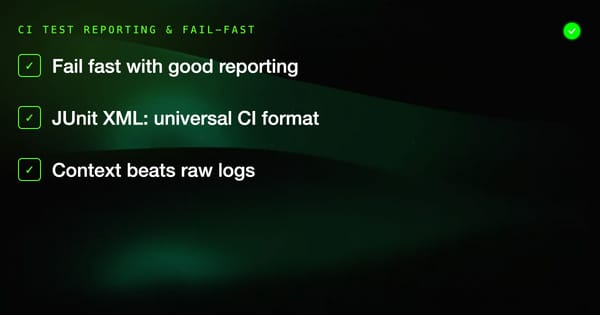
Reports are stored locally by default. Ranorex can also publish reports to a shared network location or integrate with CI systems that consume JUnit XML (Jenkins, Azure DevOps, TeamCity all support this out of the box).
The built-in report is functional but basic compared to dedicated reporting tools like Allure or ReportPortal. For teams that need dashboards, trend analysis, or flakiness tracking over time, the HTML report is a starting point, not an endpoint.
C# Extension API
Everything in Ranorex has a C# API underneath. Recorded modules compile to C# classes. Repository items are strongly typed C# objects. This means you can:
- Write custom actions in C# and use them as modules
- Import third-party .NET libraries into tests
- Use the Ranorex API directly in code modules for complex scenarios
- Debug tests with breakpoints in Visual Studio (Ranorex Studio is built on Visual Studio shell)
The dual-mode approach (GUI + code) is one of Ranorex's genuine strengths. Teams can start with the recorder, then incrementally move logic to code modules as complexity grows — without rewriting from scratch.
Cross-Browser and Cross-Platform
Ranorex supports:
- Desktop: Windows applications (Win32, WPF, WinForms, .NET MAUI, Qt, Java Swing)
- Web: Chrome, Firefox, Edge, Internet Explorer (via WebDriver)
- Mobile: iOS (via iOS WebDriver bridge), Android (via Android WebDriver bridge)
Mobile testing requires a separate Ranorex Mobile extension license. Device connections go through USB or over the network; there's no cloud device farm integration built in.
Cross-browser web testing uses the standard WebDriver protocol. Ranorex wraps it with the repository system and object spy, so the experience is consistent whether you're targeting Chrome or Firefox.
Integration Points
Ranorex integrates with:
- CI systems: Jenkins, Azure DevOps, GitHub Actions (via command-line runner), TeamCity, Bamboo
- Test management: Jira (via Ranorex Jira plugin), TestRail (via command-line results push), qTest
- Source control: Git, SVN (tests are XML and C# files that version normally)
- Defect tracking: Jira (automatic bug creation on test failure, optional)
The CI integration is mature — the command-line runner (RanorexRunner.exe) accepts parameters for suite selection, data bindings, and report output, making it straightforward to slot into any pipeline.
Licensing
Ranorex uses a node-locked or floating license model:
- Node-locked: license tied to one machine
- Floating: license server, checked out when Ranorex Studio opens
- Runtime: separate license for unattended execution on CI servers (typically cheaper than full Studio licenses)
Pricing is not published and varies by region and volume. Budget for $2,000–$3,500 per seat for Studio; runtime licenses for CI add cost on top. This is the main comparison point against open-source alternatives.
Where Ranorex Fits
Ranorex is a strong choice when:
- The team automates Windows desktop applications
- QA engineers need a GUI-driven workflow without deep coding skills
- The organization needs a commercial vendor with support contracts
- Test assets need to be maintainable by people who aren't developers
It's less compelling when:
- The stack is purely web-based (Playwright or Cypress will cost less and perform better)
- The team has strong coding skills and prefers code-first tools
- Budget constraints rule out commercial licensing
The feature set is broad and mature. The cost is the primary friction point for most evaluations.