QA Wolf vs HelpMeTest: Managed Service vs Self-Serve AI Testing

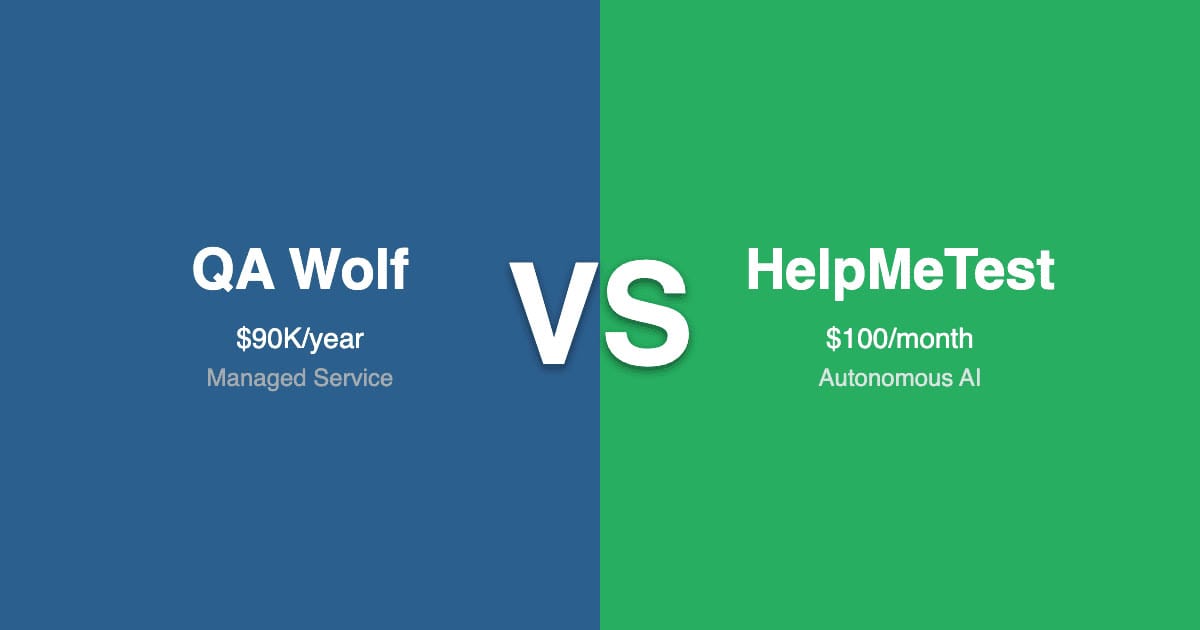
QA Wolf is a managed QA service — they write, run, and maintain your tests for you. HelpMeTest is a self-serve AI testing platform — you own the tests, the tool does the heavy lifting. QA Wolf costs $90,000–$200,000/year. HelpMeTest costs $100/month. The choice comes down to whether you want to outsource your QA function entirely or run it yourself with AI help.
Key Takeaways
QA Wolf is a service, not a tool. You're paying for a team of QA engineers to write and maintain tests on your behalf. HelpMeTest is a platform — you use it yourself, and AI handles generation and maintenance.
The price gap is not a typo. $90,000–$200,000/year (QA Wolf) vs $1,200/year (HelpMeTest Pro). That's 75–160x more expensive for QA Wolf.
QA Wolf locks in coverage; HelpMeTest gives you control. With QA Wolf, you get their team's interpretation of your flows. With HelpMeTest, you define exactly what gets tested and can update it immediately when your product changes.
HelpMeTest adds health monitoring; QA Wolf doesn't. If you need to monitor background jobs, cron tasks, and server uptime alongside your tests, HelpMeTest covers it in one product.
What each product actually is
This comparison is unusual because QA Wolf and HelpMeTest are fundamentally different categories of product.
QA Wolf is a managed QA service. You pay a team to write Playwright tests for your application, run them on every pull request, and maintain them when your UI changes. Their promise is 80% automated test coverage delivered and maintained by their engineers. You don't write the tests — they do. The appeal is that you get comprehensive test coverage without hiring QA engineers yourself.
HelpMeTest is a cloud-hosted testing platform. You use it to write tests (with AI assistance), run them, and get results. The AI handles test generation, self-healing when selectors break, and visual regression detection — but you remain in control. You define what gets tested, when, and how.
Neither approach is objectively wrong. They solve the same problem — "our app has no automated test coverage" — through completely different means.
Pricing: the real comparison
QA Wolf does not publish pricing. Based on reported numbers and market research:
- QA Wolf: $90,000–$200,000/year for a typical engineering team
- HelpMeTest Free: $0/month — 10 tests, unlimited health checks, 24/7 monitoring at 5-minute intervals
- HelpMeTest Pro: $100/month — unlimited tests, parallel execution, no per-user fees
For a 20-engineer team:
| Product | Model | Annual Cost |
|---|---|---|
| QA Wolf | Managed service | $90,000–$200,000 |
| HelpMeTest Pro | Flat-rate SaaS | $1,200 |
The difference is not 10–20%. It's 75–160x.
QA Wolf's pricing reflects what you're buying: engineering labor. You're paying QA engineers' salaries (via their service fees), plus their tooling, infrastructure, and coordination overhead. If you can justify the ROI — and many teams can, if QA hiring would cost more — the price makes sense. If you're a startup, a small team, or a team that simply doesn't have that budget, it's a different conversation.
Feature comparison
| Feature | QA Wolf | HelpMeTest |
|---|---|---|
| Test writing | Done by QA Wolf team | AI-assisted, you own the tests |
| Playwright-based tests | ✅ | ✅ (via Robot Framework + Playwright) |
| Self-healing tests | ✅ Their engineers fix them | ✅ Automatic AI maintenance |
| E2E / UI testing | ✅ | ✅ |
| API testing | ✅ | ✅ |
| Visual regression testing | ✅ | ✅ Multi-viewport, AI flaw detection |
| Health / uptime monitoring | ❌ | ✅ Grace periods, CLI heartbeats |
| CI/CD integration | ✅ | ✅ CLI + API tokens |
| Session replay | ✅ | ✅ rrweb |
| MCP integration (Claude/Cursor) | ❌ | ✅ |
| Test ownership | QA Wolf | You |
| Response to product changes | Their team (may take time) | Immediate (you update the test) |
| Pricing | $90K–$200K/year | $0–$100/month |
| No-code interface | ❌ | ❌ (CLI + MCP) |
Tests as documentation
Here's the angle most testing comparisons miss: tests aren't just checks. They're specifications.
A well-written test declares exactly what a feature is supposed to do. When a new engineer joins, they read the tests to understand expected behavior. When something breaks, the test tells you precisely what expectation failed and where. When you refactor, the tests define what "correct" means.
With QA Wolf, tests live on their platform. You can view them, but they're maintained by their engineers in their system. There's no canonical location where your team looks to understand what the checkout flow is supposed to do.
With HelpMeTest, tests are stored in your account in Robot Framework syntax — open source, human-readable. From the dashboard or via MCP in Claude Code/Cursor, any engineer can read exactly what a test checks:
*** Test Cases ***
Checkout With Valid Card
    [Documentation]    Complete purchase with valid Visa card
    Open Browser    https://myapp.com/cart
    Click Button    Proceed to Checkout
    Fill Text    input[name="card"]    4111111111111111
    Fill Text    input[name="expiry"]  12/26
    Fill Text    input[name="cvv"]     123
    Click Button    Complete Purchase
    Page Should Contain    Order confirmed
This is executable documentation. It fails the moment actual behavior diverges from the declared expectation. Any engineer can read it and know exactly what "checkout working correctly" means. You can update it immediately when the flow changes — no filing a request with a third-party team.
QA Wolf's model optimizes for you not having to think about tests. HelpMeTest's model optimizes for tests being a first-class artifact your team directly owns, reads, and controls.
The ownership question
The most underappreciated difference between the two products is test ownership.
When you use QA Wolf, their engineers write your test suite. When your product changes, you file a request, they update the tests. The turnaround depends on their availability and process. You don't have direct access to the tests in the way you'd have access to your own codebase.
When you use HelpMeTest, the tests are yours. They run in your account, you can modify them immediately, and you can add coverage whenever you discover a gap. When you ship a new feature at 2am, you can write a test for it at 2am. You don't wait for someone else's sprint.
This matters most when:
- Your product is changing quickly (early-stage companies, frequent releases)
- Your team has specific opinions about what should be covered
- You want tests to evolve with your understanding of the product
It matters less when:
- You genuinely don't have QA capacity and need someone else to handle it entirely
- Your app is relatively stable and coverage gaps are predictable
- You have budget and want the problem handed off completely
What you get from the AI layer
QA Wolf uses human engineers who write Playwright tests. They do have tooling to make this efficient, but the core value is experienced people making judgment calls about what to test.
HelpMeTest uses AI throughout:
- Test generation: Describe a flow in natural language via CLI or MCP (Claude Code/Cursor), and HelpMeTest generates Robot Framework + Playwright tests
- Self-healing: When a selector breaks because a class changed, AI identifies the element by other signals and updates the test
- Visual regression:
Check For Visual Flawskeyword detects layout breaks, visual regressions, and rendering errors across mobile, tablet, and desktop viewports - Artifacts: AI-generated documentation of your features, personas, and page descriptions that feed test context
The practical question is whether AI-generated tests match the judgment of experienced QA engineers. For most common flows — login, checkout, form submission, navigation — AI-generated tests are fast and accurate. For complex edge cases or domain-specific business logic, human judgment still adds value.
Health monitoring: a gap QA Wolf doesn't fill
One category where HelpMeTest has no equivalent in QA Wolf is server and infrastructure monitoring.
HelpMeTest's health check system monitors background jobs, cron tasks, queues, and any service that should run on a schedule:
helpmetest health my-cron-job 5mThis registers a monitor that expects a heartbeat every 5 minutes. If the job doesn't check in within the grace period, you get an alert. It auto-collects CPU, memory, and disk stats.
If your application has infrastructure beyond the browser — scheduled workers, data pipelines, background jobs — QA Wolf's Playwright tests won't cover them. HelpMeTest's health checks do.
MCP integration: you never leave your editor
With QA Wolf, your testing workflow lives in their platform. You code in one place, test in another.
HelpMeTest ships an MCP server — install it once in Claude Code or Cursor and your testing workflow moves inside your IDE permanently. You don't open a dashboard. You don't switch tools. You stay where your code is:
# In Claude Code or Cursor:
"Write a test for the checkout flow with an expired credit card"
"Run the payment tests and show me what failed"
"The login button changed from id=login to data-testid=submit — fix the tests"
The AI generates Robot Framework tests, runs them, reports results, and fixes failures — all in the same context window where you're writing code.
QA Wolf doesn't have IDE or AI coding tool integration. Their workflow is service-based: you communicate with their team, they update the tests.
If your team uses AI coding assistants daily — and increasingly, teams do — the MCP integration means testing is part of the same context as writing code. Not a separate service you contact when something breaks.
When QA Wolf makes sense
- You have no internal QA capacity and want to hand the problem off entirely
- Your team's time is better spent on product development than configuring testing tools
- You can justify $90K–$200K/year based on what in-house QA hiring would cost
- Your application is relatively mature and stable (coverage gaps are predictable)
- You want guaranteed coverage targets delivered by humans with testing expertise
When HelpMeTest makes sense
- Your budget makes $90K–$200K/year a non-starter
- You want to own and control your test suite directly
- Your product is changing fast and you need to update coverage immediately
- You use Claude Code or Cursor and want AI-native MCP integration
- You need health monitoring alongside test automation
- You're a startup, bootstrapped company, or small team where the math on managed services doesn't work
Bottom line
QA Wolf and HelpMeTest aren't competing for the same buyer. QA Wolf is for teams that want QA outsourced to experts and have the budget to make that work. HelpMeTest is for teams that want to run their own testing, affordably, with AI handling the parts that historically required QA engineering expertise.
If $90,000 is in your budget and you want to hand off the QA function entirely, QA Wolf deserves a look. If you want to pay $100/month, own your tests, and cover both UI testing and server monitoring in one tool, HelpMeTest is the practical path.
The free tier is a real starting point — 10 tests and unlimited health checks, no credit card. You can validate whether AI-powered self-serve testing covers your needs before committing to anything.
HelpMeTest is available at helpmetest.com. The free tier includes 10 tests and unlimited health checks — no credit card required.