Momentic vs HelpMeTest: Which AI Testing Tool Is Right for Your Team?

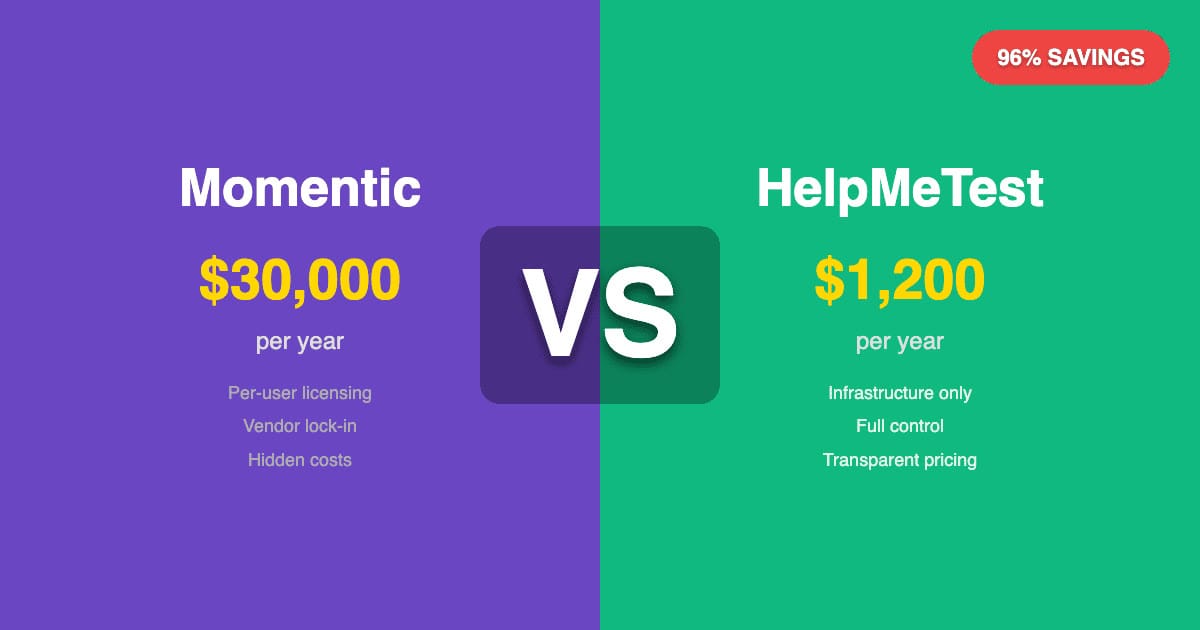
Momentic is a well-funded AI testing platform used by companies like Notion and Webflow. HelpMeTest is a flat-rate alternative at $100/month that adds server health monitoring, MCP integration for AI coding tools, and visual regression testing. If your priority is a polished no-code interface with enterprise backing, Momentic is worth evaluating. If your team needs comprehensive monitoring plus test automation without per-seat pricing, HelpMeTest is the cheaper path.
Key Takeaways
Momentic is quote-based; HelpMeTest is $100/month flat. Momentic's pricing is usage-based and not publicly listed — you need to talk to sales. HelpMeTest Pro is $100/month for unlimited tests, unlimited users.
Both tools use AI to write and maintain tests. Momentic uses AI for element location and self-healing. HelpMeTest uses AI for test generation, visual flaw detection, and artifact creation.
HelpMeTest adds health monitoring; Momentic doesn't. If you need to monitor background jobs, cron tasks, and server uptime alongside your tests, HelpMeTest covers it in the same product.
Momentic has enterprise traction; HelpMeTest targets startups and small teams. Notion, Webflow, and Quora use Momentic. HelpMeTest is built for teams where $100/month is a real number and flat-rate matters.
What each tool is
Momentic is an AI-native testing platform launched in 2024, backed by Y Combinator and General Catalyst ($4.2M raised). It's designed for end-to-end, UI, API, and accessibility testing with a no-code desktop app. Engineers record interactions, and Momentic generates the test steps. When the UI changes, AI rewrites the affected steps automatically. It targets engineering teams at product companies — customers include Notion, Webflow, Quora, Bilt, and Retool.
HelpMeTest is a cloud-hosted testing platform that combines Robot Framework + Playwright for test automation with built-in server health monitoring, visual regression testing, and an artifacts system for AI context. It has a CLI, MCP server for Claude Code and Cursor, and a flat-rate pricing model with no per-seat fees.
Neither tool requires you to write tests from scratch. Both use AI to generate and maintain them. The differences show up in pricing structure, monitoring scope, and where each tool fits in your workflow.
Feature comparison
| Feature | Momentic | HelpMeTest |
|---|---|---|
| AI test generation | ✅ No-code desktop app | ✅ Natural language via CLI/MCP |
| Self-healing tests | ✅ Intent-based, AI-rewritten | ✅ Automatic maintenance |
| E2E / UI testing | ✅ | ✅ |
| API testing | ✅ | ✅ |
| Accessibility testing | ✅ | ❌ |
| Visual regression testing | ✅ Visual diffing | ✅ Multi-viewport, AI flaw detection |
| Health / uptime monitoring | ❌ | ✅ Grace periods, CLI heartbeats |
| Browser support | Chrome/Chromium only | Chromium via Playwright |
| CI/CD integration | ✅ GitHub Actions, CircleCI, GitLab | ✅ CI/CD via CLI + API tokens |
| Session replay | ❌ | ✅ rrweb |
| MCP integration | ❌ | ✅ Claude Code, Cursor |
| Multi-tenancy | ❌ | ✅ Company isolation, subdomains |
| Pricing | Quote-based | Free / $100/month / Enterprise |
| Self-serve signup | ✅ Free trial | ✅ Free tier, no credit card |
Pricing: the clearest difference
Momentic does not publish a price list. Their model is usage-based — you pay based on test execution volume, not per seat — but the actual numbers require a sales conversation. Their enterprise page lists white-glove onboarding, custom SSO, and migration support as features, which signals the target buyer.
HelpMeTest publishes its pricing directly:
- Free: $0/month — 10 tests, unlimited health checks, 24/7 monitoring at 5-minute intervals, email alerts, CI/CD integration
- Pro: $100/month — unlimited tests, parallel execution, 3-month data retention, no per-user fees
- Enterprise: Contact sales — 10-second monitoring intervals, SSO, priority support
For a 20-engineer team, the cost comparison:
| Tool | Model | 20-User Annual Cost |
|---|---|---|
| Momentic | Usage-based, quote | $18,000–$36,000 (estimated) |
| HelpMeTest | Flat-rate | $1,200 |
The Momentic estimate reflects typical usage-based SaaS pricing for teams of that size; actual quotes vary. HelpMeTest at $100/month is $1,200/year regardless of how many people are on the team.
If budget is not a constraint and you want a tool with enterprise-grade onboarding and migration support, Momentic's pricing is worth exploring. If you want to avoid the sales process and know exactly what you'll pay, HelpMeTest starts at free and tops out at $100/month.
Where each tool fits
Choose Momentic when:
- You want a polished no-code desktop experience for recording and editing tests
- Your team is at a product company with dedicated QA engineers
- You need accessibility auditing built in
- Enterprise support and white-glove onboarding justify the cost
- You're migrating from Selenium, Cypress, or Playwright and need migration support
Choose HelpMeTest when:
- You need both test automation and server health monitoring in one product
- Flat-rate pricing matters — $100/month for the whole team, no surprises
- You use Claude Code or Cursor and want MCP integration for AI-driven testing
- You run cron jobs, background workers, or services that need heartbeat monitoring
- You want visual regression testing across mobile, tablet, and desktop viewports
- You're a startup or bootstrapped company where the sales process is friction you can skip
The health monitoring gap
The clearest functional gap between the two tools is monitoring scope.
Momentic tests your web application. HelpMeTest tests your web application and monitors everything else running alongside it — background jobs, cron tasks, queues, API health, and server uptime.
HelpMeTest's health check system uses grace periods: you define a job that should run every 5 minutes, and if it doesn't check in within that window, you get alerted. The CLI command is:
helpmetest health my-cron-job 5mThat's one line added to any cron script or background worker. No separate monitoring tool required.
If your testing scope is browser-based UI flows only, this difference doesn't matter. If your application involves workers, scheduled jobs, or APIs that need to be alive for the UI to work, HelpMeTest covers the full picture.
AI integration: you never open a testing dashboard
Momentic is a standalone desktop app. You write code in your editor, then switch to Momentic to record tests, view results, and manage your test suite. Two separate contexts, two separate tools.
HelpMeTest ships an MCP server — install it once in Claude Code or Cursor and your testing workflow moves inside your IDE permanently:
# In Claude Code or Cursor:
"Write a test for the onboarding flow — user signs up, confirms email, sees dashboard"
"Run the signup tests and tell me what failed"
"The submit button changed — update the tests"
The AI generates Robot Framework tests, runs them, and reports results inside your editor. You never open a testing dashboard. Test failures appear in the same context window where you're writing code, so you can fix them without switching tools.
Tests that declare what your app is supposed to do
When you use Momentic's desktop app, you interact with a testing platform. The tests live there, you view them there.
When you use HelpMeTest, tests are stored in your account in Robot Framework syntax — open source, human-readable. From the dashboard or via MCP in your editor:
*** Test Cases ***
New User Onboarding
    [Documentation]    User completes signup and reaches dashboard
    Go To    https://myapp.com/signup
    Fill Text    input[name="email"]    user@example.com
    Fill Text    input[name="password"]    securepass123
    Click Button    Create Account
    Page Should Contain    Check your email
    # (simulate email confirmation)
    Go To    https://myapp.com/dashboard
    Page Should Contain    Welcome
This test is a precise specification: it declares that signup should behave exactly this way. Any engineer can read it and know what "onboarding working correctly" means. When the flow changes, you update it directly — no need to re-record in a desktop app or wait for AI to reinterpret your intent. The test content is in Robot Framework format — an open standard, not a proprietary format locked to Momentic or any other platform.
Bottom line
Momentic is a serious tool with real enterprise traction. If you're at a company like the ones listed on their site — Notion-scale, dedicated QA team, accessibility requirements — it's worth getting a quote.
For teams where $100/month is real money and you want to cover test automation, visual regression, and server monitoring without three separate tools, HelpMeTest is the simpler path. The free tier is enough to get started and confirm whether it fits your stack before committing to anything.
HelpMeTest is available at helpmetest.com. The free tier includes 10 tests and unlimited health checks — no credit card required.