RabbitMQ vs NATS vs Kafka Testing DX: Which Is Easiest to Test?

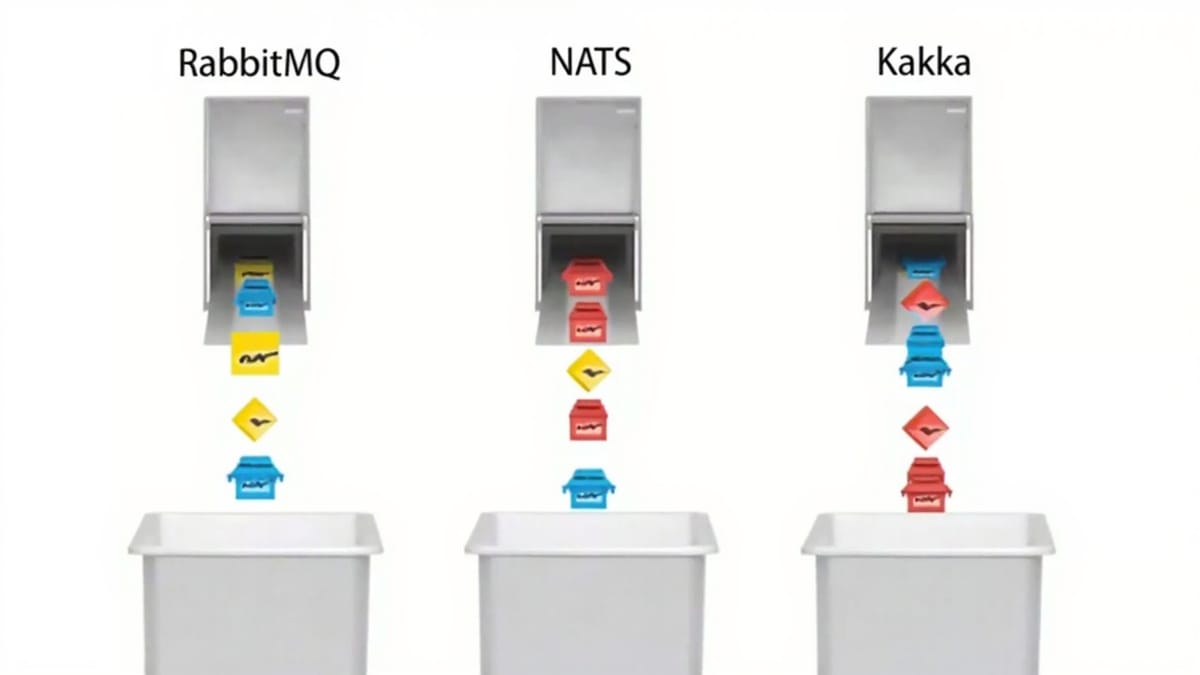
RabbitMQ, NATS, and Kafka have dramatically different testing developer experiences. NATS wins on speed and simplicity with its embedded server. RabbitMQ is straightforward with Testcontainers. Kafka requires the most setup but has the richest ecosystem for testing. This comparison helps you understand what you're signing up for before choosing a broker — and how to test whichever one you have.
Key Takeaways
NATS has the best testing DX. Embedded server in-process, no Docker, tests start in milliseconds. The clear winner for test simplicity.
RabbitMQ is easy with Testcontainers. One container, fast startup (~5s), straightforward AMQP test patterns. Good middle ground.
Kafka is the hardest to test correctly. Multiple Testcontainers, slow startup (15-30s), more moving parts. EmbeddedKafka helps but has limits.
Test the message guarantees your broker promises. RabbitMQ's DLQ, NATS JetStream at-least-once, Kafka offset commits — these are what your broker was chosen for. If you don't test them, you don't know they work.
CI test time grows with broker complexity. A NATS test suite takes seconds. A Kafka test suite with EmbeddedKafka takes minutes. Design your test architecture knowing this.
Why Testing DX Matters for Broker Choice
You'll spend more time writing tests than you spent choosing your broker. A broker that's hard to test reliably leads to: flaky CI pipelines, skipped integration tests ("too slow"), and production bugs that could have been caught. Before picking a message broker, consider not just the runtime characteristics but how easy it is to test.
This comparison covers the three most commonly used brokers in production: RabbitMQ, NATS (with JetStream), and Apache Kafka.
Setup Complexity Comparison
NATS — Embedded In-Process
NATS wins outright on setup simplicity:
// Zero external dependencies. Pure Go.
import natsserver "github.com/nats-io/nats-server/v2/test"

func TestWithNATS(t *testing.T) {
    s := natsserver.RunServer(&server.Options{
        Port:      -1,
        JetStream: true,
        StoreDir:  t.TempDir(),
    })
    defer s.Shutdown()
    // Write your test
}No Docker. No container orchestration. The full NATS server — including JetStream persistence, key-value store, and message routing — runs in the same process as your tests.
Setup score: 10/10 — install one Go package, done.
RabbitMQ — Testcontainers
RabbitMQ doesn't have an embeddable broker, but Testcontainers makes it nearly painless:
# Python
from testcontainers.rabbitmq import RabbitMqContainer

@pytest.fixture(scope="session")
def rabbitmq():
    with RabbitMqContainer("rabbitmq:3.12-management") as c:
yield c.get_connection_url()Container starts in 3-5 seconds. The rabbitmq image is stable and well-tested. You get the full broker — exchanges, queues, bindings, DLQs, virtual hosts.
Setup score: 8/10 — requires Docker, but Testcontainers abstracts everything cleanly.
Kafka — Most Complex
Kafka requires a ZooKeeper node (or KRaft) plus a broker. Testcontainers has Kafka support, but it's heavier:
// Java — needs kafka + (optionally) schema registry containers
@Testcontainers
class KafkaTest {
    @Container
    static KafkaContainer kafka = new KafkaContainer(
        DockerImageName.parse("confluentinc/cp-kafka:7.6.0")
    );

    // Startup time: 15-30 seconds
    // Schema Registry: add another container if using Avro
}Spring Boot's @EmbeddedKafka simplifies this but has known issues with complex consumer group scenarios and rebalancing behavior that differs from real Kafka.
Setup score: 5/10 — heavier, slower, more configuration required.
Test Speed Comparison
| Broker | Cold start | Per-test overhead | Shared fixture startup |
|---|---|---|---|
| NATS (embedded) | <100ms | <10ms | ~50ms |
| RabbitMQ (Testcontainers) | 3-8s | <50ms | 3-8s (once) |
| Kafka (Testcontainers) | 15-30s | 100-500ms | 15-30s (once) |
| Kafka (EmbeddedKafka) | 5-10s | 50-200ms | 5-10s |
With proper session-scoped fixtures (start once per test run), RabbitMQ and NATS are both fast in CI. Kafka is always slower.
Message Delivery Guarantee Testing
This is where the comparison gets interesting — each broker promises different delivery guarantees, and you need different tests to verify them.
RabbitMQ: At-Least-Once via Acks
RabbitMQ's reliability comes from explicit message acknowledgements and dead letter queues:
# Test that unacked messages are redelivered
def test_unacked_message_redelivered(rabbit_service):
    rabbit_service.declare_queue("tasks")
    rabbit_service.publish("tasks", {"task": "process"})

    ch = rabbit_service._channel
    method, _, body = ch.basic_get("tasks", auto_ack=False)
    ch.basic_nack(delivery_tag=method.delivery_tag, requeue=True)

    # Should be available again
    method2, _, body2 = ch.basic_get("tasks", auto_ack=True)
assert method2 is not NoneNATS JetStream: At-Least-Once via Consumer Position
NATS JetStream tracks consumer position. Unacked messages are redelivered on restart:
// Test durable consumer replays from last ack
func TestDurableReplay(t *testing.T) {
    // ... publish, receive without ack, restart consumer
    // Verify message is redelivered
}Kafka: At-Least-Once via Offset Commits
Kafka's guarantees come from offset management. Testing requires consumer group coordination:
// Test that uncommitted offset causes replay on restart
@Test
void uncommittedOffsetReplaysOnRestart() {
    // Produce message
    // Consume but don't commit offset
    // Close consumer, create new with same group
    // Verify message is replayed from uncommitted offset
}Kafka offset testing is the most complex because consumer group rebalancing adds latency you must account for.
Integration Test Patterns Side by Side
Publishing and Consuming
RabbitMQ (Python)
def test_publish_consume(rabbit_service):
    rabbit_service.declare_queue("test.q")
    rabbit_service.publish("test.q", {"data": "hello"})
    msg = rabbit_service.consume_one("test.q")
assert msg == {"data": "hello"}NATS (Go)
func TestPublishConsume(t *testing.T) {
    // ... setup JetStream, create stream
    ack, _ := js.Publish("orders.new", []byte(`{"data":"hello"}`))
    sub, _ := js.SubscribeSync("orders.new")
    msg, _ := sub.NextMsg(2 * time.Second)
    assert.Equal(t, `{"data":"hello"}`, string(msg.Data))
}Kafka (Java)
@Test
void testPublishConsume() {
    kafkaTemplate.send("test-topic", "key", "hello");

    ConsumerRecords<String, String> records = consumer.poll(Duration.ofSeconds(5));
    assertEquals(1, records.count());
    assertEquals("hello", records.iterator().next().value());
}Dead Letter / Failure Routing
| Broker | DLQ mechanism | Test difficulty |
|---|---|---|
| RabbitMQ | Dead letter exchange + binding | Medium — requires exchange setup |
| NATS | No built-in DLQ; use error subjects | Easy — just test error subject subscription |
| Kafka | Dead letter topic via framework config | Hard — depends on consumer framework |
Feature Coverage by Test Type
| Test scenario | RabbitMQ | NATS | Kafka |
|---|---|---|---|
| Basic send/receive | ✓ Easy | ✓ Easy | ✓ Medium |
| Message ordering | ✓ Per-queue | ✓ Per-subject | ✓ Per-partition |
| At-least-once delivery | ✓ Ack/nack | ✓ JetStream ack | ✓ Offset commit |
| DLQ/dead letter | ✓ Easy | ➕ Manual | ⚠️ Framework-dependent |
| Consumer groups | ❌ Not applicable | ✓ Durable consumers | ✓ Complex to test |
| Schema enforcement | ❌ Manual | ❌ Manual | ✓ Schema Registry |
| Replay/time travel | ❌ DLQ only | ✓ JetStream | ✓ Offset seek |
| Embedded testing | ❌ | ✓ | ⚠️ EmbeddedKafka |
Which Should You Use for Testing?
Choose NATS if:
- You're building a new system and testing simplicity matters
- Your team writes Go
- You need fast CI feedback loops
- You want to avoid Docker in your test environment
Choose RabbitMQ if:
- You need sophisticated routing (topic exchanges, header routing)
- Your team is familiar with AMQP
- You need strong DLQ guarantees with simple configuration
Choose Kafka if:
- You need event log replay and time travel
- Your system requires strict message ordering across consumer groups
- You're integrating with a larger data platform
- Testing complexity is an acceptable trade-off for Kafka's durability guarantees
Practical Testing Rules for Any Broker
Regardless of which broker you use, test these scenarios:
- Happy path — message published reaches the consumer with correct content
- Consumer failure — message is not lost when consumer crashes before ack/commit
- Dead letter path — poison messages land in the right place after max retries
- Schema validation — malformed messages are rejected at the right boundary
- Concurrent consumers — multiple consumers don't double-process the same message
These five tests cover the delivery contract your broker promises. If all five pass, you know your integration is correct. If you skip them, you're trusting documentation rather than proof.
Connecting to HelpMeTest
Message broker tests verify your async messaging contracts, but they don't tell you whether your system works end-to-end in production. HelpMeTest runs end-to-end flow tests on a schedule — publish a message, verify the downstream effect, get alerted if the chain breaks. It complements your broker integration tests with continuous production verification.
Summary
| NATS | RabbitMQ | Kafka | |
|---|---|---|---|
| Setup complexity | Low | Medium | High |
| Test speed | Fast (<100ms) | Fast (3-8s cold) | Slow (15-30s) |
| Embedded broker | Yes | No | Partial |
| DLQ testing | Manual | Built-in | Framework-dependent |
| Delivery guarantee testing | JetStream ack | AMQP ack/nack | Offset commit |
NATS wins on developer experience. RabbitMQ is the easiest traditional broker. Kafka is the most powerful but requires the most investment in test infrastructure. Choose based on your runtime requirements, then invest proportionally in your test setup.