DeepEval and Promptfoo: Automated LLM Evaluation Frameworks and CI/CD Integration

Shipping LLM features without automated evaluation is like deploying code without running tests. DeepEval and Promptfoo are the two leading open-source frameworks for automating LLM evaluation — they let you define quality metrics, run them against your prompts, and fail CI when quality drops.
This guide covers both tools: what they do well, when to use each, and how to integrate them into your deployment pipeline.
Why Dedicated Evaluation Frameworks?
You could write ad-hoc evaluation scripts with a judge LLM and some assertions. The problem: metrics implemented from scratch are inconsistent, lack established benchmarks, and don't integrate cleanly with CI/CD. DeepEval and Promptfoo solve this with:
- Standardized metrics (G-Eval, faithfulness, answer relevancy, etc.)
- Test case management — define cases in YAML/JSON, version them in git
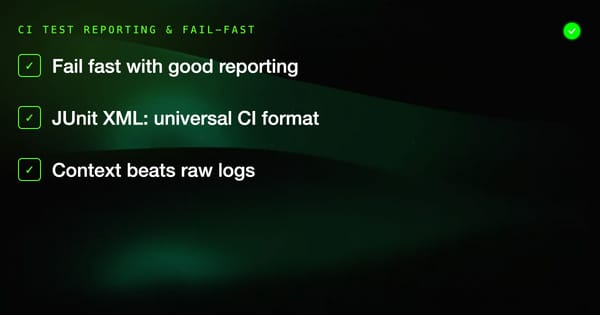
- CI/CD integration — exit codes, JUnit XML, GitHub Actions support
- Regression tracking — compare results across runs
- Cost control — built-in caching and model selection
DeepEval
DeepEval is a Python-based evaluation framework. It provides a pytest-like interface for writing LLM evaluation tests with a rich set of built-in metrics.
Installation
pip install deepevalBasic Usage
from deepeval import assert_test
from deepeval.test_case import LLMTestCase
from deepeval.metrics import (
    AnswerRelevancyMetric,
    FaithfulnessMetric,
    ContextualPrecisionMetric,
    HallucinationMetric,
)

def test_customer_support_response():
    test_case = LLMTestCase(
        input="What is your return policy?",
        actual_output="You can return items within 30 days for a full refund.",
        expected_output="Returns are accepted within 30 days.",
        retrieval_context=[
            "All purchases come with a 30-day money-back guarantee.",
            "Contact support@example.com to initiate a return."
        ]
    )

    assert_test(test_case, [
        AnswerRelevancyMetric(threshold=0.8),
        FaithfulnessMetric(threshold=0.9),
        ContextualPrecisionMetric(threshold=0.7),
])Run it like pytest:
deepeval test run tests/test_customer_support.pyRunning with pytest
DeepEval integrates directly with pytest:
import pytest
from deepeval import assert_test
from deepeval.test_case import LLMTestCase
from deepeval.metrics import AnswerRelevancyMetric, GEval
from deepeval.test_case import LLMTestCaseParams

# Custom metric using G-Eval (GPT-based evaluation with custom criteria)
professionalism_metric = GEval(
    name="Professionalism",
    criteria="The response is professional, courteous, and appropriate for customer service.",
    evaluation_params=[LLMTestCaseParams.ACTUAL_OUTPUT],
    threshold=0.7
)

@pytest.mark.parametrize("test_case", [
    LLMTestCase(
        input="I'm angry about my order being late!",
        actual_output=get_your_llm_response("I'm angry about my order being late!"),
        expected_output="Apology and assistance offered."
    ),
    LLMTestCase(
        input="Cancel my subscription NOW",
        actual_output=get_your_llm_response("Cancel my subscription NOW"),
        expected_output="Subscription cancellation acknowledged."
    ),
])
def test_customer_responses_are_professional(test_case):
assert_test(test_case, [professionalism_metric])DeepEval Metrics
DeepEval ships with 14+ ready-to-use metrics:
| Metric | Use Case |
|---|---|
AnswerRelevancyMetric |
Does the answer address the question? |
FaithfulnessMetric |
Is the answer supported by context? |
ContextualPrecisionMetric |
Are retrieved chunks relevant? |
ContextualRecallMetric |
Does retrieved context cover the answer? |
HallucinationMetric |
Does the answer contradict context? |
GEval |
Custom criteria via LLM judge |
ToxicityMetric |
Does output contain harmful content? |
BiasMetric |
Does output contain biases? |
SummarizationMetric |
Is the summary accurate and complete? |
Writing Custom Metrics
from deepeval.metrics import BaseMetric
from deepeval.test_case import LLMTestCase

class ResponseLengthMetric(BaseMetric):
    def __init__(self, max_words: int = 100, threshold: float = 1.0):
        self.max_words = max_words
        self.threshold = threshold
        self.name = "Response Length"

    def measure(self, test_case: LLMTestCase) -> float:
        word_count = len(test_case.actual_output.split())
        if word_count <= self.max_words:
            self.score = 1.0
            self.success = True
        else:
            self.score = self.max_words / word_count
            self.success = self.score >= self.threshold
        return self.score

    def is_successful(self) -> bool:
        return self.success

    @property
    def __name__(self):
return self.nameDataset-Level Evaluation
Evaluate a batch of test cases together:
from deepeval import evaluate
from deepeval.test_case import LLMTestCase
from deepeval.metrics import AnswerRelevancyMetric

test_cases = [
    LLMTestCase(
        input=q["question"],
        actual_output=your_llm(q["question"]),
        expected_output=q["expected"]
    )
    for q in load_test_dataset("tests/fixtures/qa_dataset.json")
]

results = evaluate(test_cases, [AnswerRelevancyMetric(threshold=0.8)])

# Access aggregate results
print(f"Pass rate: {results.passing_cases / results.total_cases:.0%}")Promptfoo
Promptfoo takes a YAML-first, config-driven approach. You define prompts, providers, and test cases in YAML, and Promptfoo runs them — no Python required.
Installation
npm install -g promptfoo
# or
npx promptfoo@latestBasic Configuration
# promptfooconfig.yaml
description: Customer Support Bot Evaluation

prompts:
  - id: support-prompt
    raw: |
      You are a customer support agent for Acme Corp.
      Be helpful, professional, and concise.

      Customer message: {{message}}

providers:
  - id: openai:gpt-4o-mini
  - id: openai:gpt-4o  # compare both models

tests:
  - vars:
      message: "What is your return policy?"
    assert:
      - type: contains
        value: "30 days"
      - type: llm-rubric
        value: "The response is helpful and mentions the return window"
      - type: not-contains
        value: "I don't know"

  - vars:
      message: "I want to cancel my subscription"
    assert:
      - type: llm-rubric
        value: "The agent offers to help with cancellation and asks for account details"
      - type: javascript
        value: "output.length < 300"  # concise response

  - vars:
      message: "Your service is terrible!"
    assert:
      - type: llm-rubric
        value: "The agent responds empathetically and offers to help resolve the issue"
      - type: not-regex
value: "terrible|awful|bad" # don't mirror negative languageRun it:
promptfoo eval

# View results in browser
promptfoo viewPromptfoo Assertion Types
| Type | Example |
|---|---|
contains |
value: "return policy" |
not-contains |
value: "I don't know" |
regex |
value: "\\d+ days" |
llm-rubric |
value: "Response is professional" |
javascript |
value: "output.includes('30') && output.length < 200" |
similarity |
value: "Returns accepted in 30 days", threshold: 0.8 |
factuality |
Check factual accuracy vs expected |
answer-relevance |
Relevance to the prompt |
context-faithfulness |
Answer grounded in context |
Provider Comparison
Promptfoo excels at comparing multiple providers and models:
providers:
  - id: openai:gpt-4o
  - id: openai:gpt-4o-mini
  - id: anthropic:claude-3-5-sonnet-20241022
  - id: ollama:llama3  # local model

tests:
  - vars:
      question: "Explain quantum entanglement simply"
    assert:
      - type: llm-rubric
        value: "Explanation is accurate and accessible to a non-physicist"
      - type: javascript
value: "output.length > 100 && output.length < 500"The output table shows pass/fail for each provider × test combination — great for model selection decisions.
Prompt Variants
Test different prompt versions:
prompts:
  - id: concise
    raw: "Answer in 2 sentences: {{question}}"
  - id: detailed
    raw: "Provide a thorough answer to: {{question}}"
  - id: structured
    raw: |
      Answer this question: {{question}}
Format: bullet points, max 5 bullets.Promptfoo shows which prompt performs best across your test suite.
Regression Detection
# Track against a baseline
commandLineOptions:
  cache: true  # cache API responses for reproducibility

sharing:
  enabled: true  # share results URL for team review

defaultTest:
  options:
    # Fail if score drops more than 10% from baseline
rubricPrompt: "Score this response 1-5..."# Compare current run to a saved baseline
promptfoo eval --compare baseline_output.jsonCI/CD Integration
DeepEval in GitHub Actions
name: LLM Eval
on: [push, pull_request]

jobs:
  eval:
    runs-on: ubuntu-latest
    steps:
      - uses: actions/checkout@v4
      - uses: actions/setup-python@v5
        with:
          python-version: '3.11'

      - run: pip install deepeval

      - name: Run DeepEval tests
        run: deepeval test run tests/eval/
        env:
          OPENAI_API_KEY: ${{ secrets.OPENAI_API_KEY }}

      - name: Upload results
        if: always()
        uses: actions/upload-artifact@v4
        with:
          name: deepeval-results
path: deepeval-results.jsonPromptfoo in GitHub Actions
name: Promptfoo Eval
on: [pull_request]

jobs:
  eval:
    runs-on: ubuntu-latest
    steps:
      - uses: actions/checkout@v4

      - name: Install Promptfoo
        run: npm install -g promptfoo

      - name: Run Promptfoo evaluation
        run: |
          promptfoo eval --output results.json
          promptfoo eval --output results.csv
        env:
          OPENAI_API_KEY: ${{ secrets.OPENAI_API_KEY }}

      - name: Check pass rate
        run: |
          PASS_RATE=$(jq '.results.stats.passRate' results.json)
          echo "Pass rate: $PASS_RATE"
          python3 -c "import sys; sys.exit(0 if float('$PASS_RATE') >= 0.85 else 1)"

      - name: Comment PR with results
        uses: actions/github-script@v7
        if: always()
        with:
          script: |
            const fs = require('fs');
            const results = JSON.parse(fs.readFileSync('results.json'));
            const stats = results.results.stats;
            const body = `## LLM Eval Results
            - Pass rate: ${(stats.passRate * 100).toFixed(1)}%
            - Tests passed: ${stats.successes}/${stats.total}`;
            github.rest.issues.createComment({
              issue_number: context.issue.number,
              owner: context.repo.owner,
              repo: context.repo.repo,
              body
});DeepEval vs Promptfoo: When to Use Each
| Scenario | Tool |
|---|---|
| Python-heavy team | DeepEval |
| YAML-first, non-Python team | Promptfoo |
| RAG evaluation | DeepEval (better RAG metrics) |
| Multi-model comparison | Promptfoo (built for this) |
| Custom Python metrics | DeepEval |
| Prompt A/B testing | Promptfoo |
| pytest integration | DeepEval |
| No-code evaluation | Promptfoo |
Many teams use both: Promptfoo for prompt iteration and model comparison during development, DeepEval for rigorous quality gates in CI.
Practical Evaluation Strategy
- Start small — 10-20 high-quality test cases beat 500 bad ones
- Cover your failure modes — edge cases, adversarial inputs, and known regressions
- Set realistic thresholds — 0.95 faithfulness is not achievable; start with 0.80
- Cache API responses — both tools support caching; use it to reduce costs
- Track trends — a score of 0.82 today is fine; a drop from 0.91 last week is a regression
# DeepEval: cache results
deepeval test run --cache

# Promptfoo: enable caching in config
# cache: true (in promptfooconfig.yaml)DeepEval and Promptfoo turn LLM quality from a vague concern into a measurable, CI-gated property. Pick the one that fits your team's workflow — or use both. The goal is the same: catch prompt regressions before your users do.