API Contract Testing: Comparing Pact, Dredd, and Schemathesis

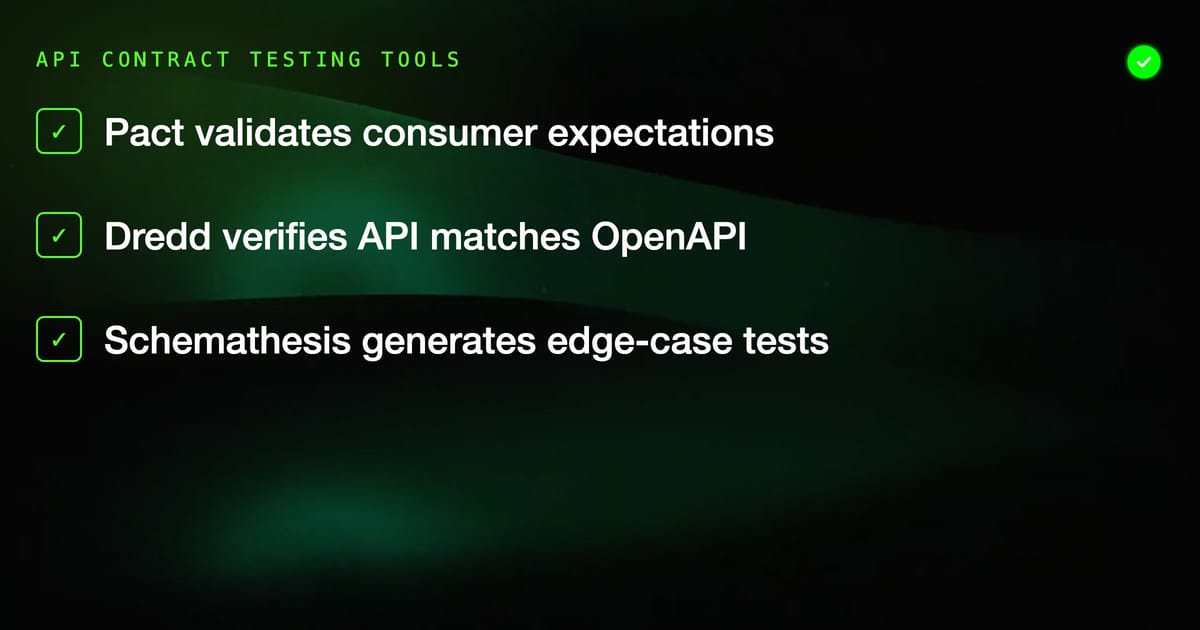
Pact, Dredd, and Schemathesis are three different approaches to API contract testing, each solving a different part of the problem. Pact validates what individual consumers expect. Dredd validates that an implementation matches its OpenAPI/API Blueprint spec. Schemathesis uses property-based testing to automatically generate edge-case requests from an OpenAPI spec and find bugs the spec writer didn't anticipate.
Key Takeaways
Pact is consumer-driven; Dredd and Schemathesis are spec-driven. Pact contracts come from consumer test code. Dredd and Schemathesis contracts come from OpenAPI documents. Different input sources, different blind spots.
Dredd tests what you documented; Schemathesis tests your documentation's completeness. Dredd verifies that your API behaves as the spec says it should. Schemathesis generates hundreds of edge-case requests from the spec and looks for 5xx errors, schema violations, and undefined behavior — things Dredd won't catch.
Use all three for different purposes, not as alternatives. Pact for inter-service consumer contracts. Dredd for documentation-as-tests. Schemathesis for property-based fuzzing of your API surface.
Dredd is simple to set up; Schemathesis requires more investment but finds real bugs. Dredd is a quick win for "does my API match my OpenAPI spec." Schemathesis requires understanding stateful testing for APIs with dependencies but finds classes of bugs that manual testing misses.
None of these replace integration testing. All three test API contracts — the shape and semantics of requests and responses. They don't test business logic, authorization flows, or distributed system behavior.
Three Approaches to API Contract Testing
API contract testing is a broad category. Three distinct tools cover different aspects:
| Tool | What it tests | Contract source | Test generation |
|---|---|---|---|
| Pact | Individual consumer expectations | Consumer test code | Manual (consumer writes tests) |
| Dredd | OpenAPI spec compliance | OpenAPI / API Blueprint file | Automatic from spec |
| Schemathesis | API robustness against spec edge cases | OpenAPI spec | Property-based (automatic) |
Understanding when to use each requires understanding what each tests.
Pact
What It Tests
Pact tests whether a provider honors the specific expectations of each consumer. If order-service expects GET /products/:id to return { id, name, price }, Pact verifies that product-service actually returns those fields.
Pact is driven by real consumer usage — the consumer writes tests that define exactly what fields it reads and what HTTP status codes it handles. The contract reflects actual consumption, not theoretical API design.
How It Works
- Consumer writes interaction tests using the Pact library
- Tests run against a Pact mock server, generating a pact JSON file
- Pact file published to Pact Broker
- Provider fetches pact files and runs verification against the real service
- Verification results published; can-i-deploy gates production deploys
When to Use Pact
- Internal microservices with multiple consumers
- You want to track exactly which consumers use which API fields
- You want can-i-deploy deployment safety checks
- Your team is polyglot (Pact supports any language)
What Pact Doesn't Cover
- Fields the API returns but no consumer currently uses
- Undocumented behavior that no consumer has tested
- Edge cases at parameter boundaries
Dredd
What It Tests
Dredd tests whether an API implementation matches its documentation (OpenAPI spec or API Blueprint). You give Dredd a spec file and an API base URL, and it generates requests from the spec's example values and verifies that responses match.
Dredd is documentation-as-tests: your OpenAPI spec is the test suite.
How It Works
# Install
npm install -g dredd

# Run against a local server with an OpenAPI spec
dredd openapi.yaml http://localhost:3000Dredd:
- Reads each path and operation in the spec
- Constructs a request using the spec's example values
- Sends the request to the API
- Verifies the response status code and body against the spec
Configuration
# dredd.yml
dry-run: false
hookfiles: "./dredd-hooks.js"
language: nodejs
sandbox: false
server: "npm start"
server-wait: 3
endpoint: "http://localhost:3000"
path:
  - "./openapi.yaml"
blueprint: "./openapi.yaml"
reporter: "xunit"
output: "dredd-results.xml"Hooks: Setting Up Test Data
Dredd doesn't know about your data model. Before testing a GET /users/:id endpoint, a user with that ID must exist. Hooks let you set up data:
// dredd-hooks.js
const hooks = require("hooks");

hooks.before("Users > Get user by ID > 200", async (transaction, done) => {
  // Create the test user before Dredd calls GET /users/123
  await db.users.create({ id: 123, name: "Test User", email: "test@example.com" });
  done();
});

hooks.after("Users > Get user by ID > 200", async (transaction, done) => {
  // Clean up
  await db.users.delete({ id: 123 });
  done();
});Strengths
- Fast to set up (just point at an OpenAPI file)
- Keeps documentation and implementation in sync
- Clear pass/fail per operation
- Good CI integration
Limitations
- Tests only what's in the spec examples (no edge cases)
- Requires hooks for stateful tests (CRUD ordering, auth setup)
- Doesn't test combinations of parameters
- Won't find bugs the spec writer didn't document
What Dredd Misses
If your spec says GET /orders/:id returns a 200 with a body — Dredd tests exactly that. It won't test:
- What happens with a non-existent ID (404 behavior)
- What happens with an invalid ID format (400 behavior)
- What happens when the database is slow
- What happens with authentication edge cases
Dredd is a great CI check for "my implementation matches my docs." It's not a comprehensive API test.
Schemathesis
What It Tests
Schemathesis uses property-based testing against an OpenAPI spec. Instead of testing spec examples, it generates hundreds of valid (and intentionally edge-case) requests based on the parameter schemas, then looks for:
- HTTP 5xx responses (server errors)
- Responses that don't match the declared schema
- Responses that contradict the spec (wrong status code, missing fields)
- Internal server errors on otherwise-valid inputs
The insight: if your spec says a parameter is type: string, maxLength: 100, Schemathesis will test with an empty string, a 100-character string, a 101-character string, a string with special characters, a null value, and many more.
How It Works
# Install
pip install schemathesis

# Run against a live API
st run http://localhost:3000/openapi.json --checks all

# Or against a spec file
st run openapi.yaml --base-url http://localhost:3000 --checks allOutput:
GET /users/{id}
  - Query: id=0
    Response: 200 OK (valid)
  - Query: id=-1
    Response: 500 Internal Server Error  ← bug found
  - Query: id=9999999999
Response: 400 (expected 200 or 404) ← potential issueStateful Testing
Schemathesis supports stateful testing — linking API calls together in order. For a CRUD API: first POST to create, then GET to read, then DELETE:
st run http://localhost:3000/openapi.json \
  --stateful=links \
--checks allWhen OpenAPI responses include links (OpenAPI 3.0 feature), Schemathesis chains calls automatically.
CI Integration
# .github/workflows/schemathesis.yml
- name: Run Schemathesis
  run: |
    st run http://localhost:3000/openapi.json \
      --checks all \
      --max-response-time 2000 \
      --report schemathesis-report.json


- name: Upload results
  if: always()
  uses: actions/upload-artifact@v4
  with:
    name: schemathesis-report
path: schemathesis-report.jsonWhat Schemathesis Finds That Dredd Misses
Real-world bugs Schemathesis regularly finds:
- Integer overflow errors (ID fields that crash on large numbers)
- SQL injection via unescaped string parameters
- Null pointer exceptions on empty strings in required fields
- Off-by-one errors in maxLength validation
- Type coercion bugs (accepting
"123"where spec saysinteger)
Limitations
- Requires a running API (not spec-only testing)
- Stateful testing requires careful setup for auth and data dependencies
- Can generate a lot of noise if API has known quirks for edge cases
- Slower than Dredd (generates many requests per endpoint)
Side-by-Side Comparison
| Dimension | Pact | Dredd | Schemathesis |
|---|---|---|---|
| Contract source | Consumer test code | OpenAPI / API Blueprint | OpenAPI spec |
| Test generation | Manual | Automatic (examples) | Property-based (generated) |
| Consumer tracking | Yes | No | No |
| Finds undocumented bugs | No | No | Yes |
| Setup complexity | High | Low | Medium |
| Language | Polyglot | Any (CLI) | Python CLI + library |
| CI integration | Strong | Good | Good |
| State management | Provider state handlers | Hooks | Stateful mode |
| Best for | Internal service contracts | Spec compliance | Edge case discovery |
Recommended Combination
The tools are complementary, not competing:
- Dredd in CI: Fast check that your implementation matches your OpenAPI spec. Catches regressions when code diverges from documentation. Easy to add to any pipeline.
- Pact for inter-service contracts: Between internal microservices that have specific consumer expectations. Provides deployment safety via can-i-deploy.
- Schemathesis on a schedule: Run nightly or pre-release. Takes longer than Dredd but finds real bugs that example-based testing misses.
If you have to pick one for an API that external consumers use:
- If you own both the spec and implementation: Dredd + Schemathesis
- If you have specific internal consumers: Pact
- If you're starting from scratch and want the easiest win: Dredd
Contract testing is about confidence. Use whichever combination gives you the confidence that your API behaves as expected — for your known consumers and for edge cases you haven't thought of.