
The Agile Testing Quadrant Explained: Q1 Through Q4
Most teams have a testing gut feeling—they write unit tests, some integration tests, maybe some end-to-end tests.

Most teams have a testing gut feeling—they write unit tests, some integration tests, maybe some end-to-end tests. What they often lack is a framework for thinking about why each type of test exists and what purpose it serves.
The Agile Testing Quadrant provides that framework. Developed by Brian Marick and popularized by Lisa Crispin and Janet Gregory in Agile Testing, it organizes tests along two axes: who the tests support and whether they critique or guide.
The Two Axes
Axis 1: Technology-facing vs Business-facing
- Technology-facing tests are written in terms programmers understand: functions, classes, APIs, database queries
- Business-facing tests are written in terms stakeholders and domain experts understand: features, user stories, acceptance criteria
Axis 2: Supporting the team vs Critiquing the product
- Supporting the team: tests that guide development, written during development, fail-early feedback
- Critiquing the product: tests that evaluate whether the software is fit for purpose—often exploratory, adversarial, or user-focused
The Four Quadrants
                    Business-facing
                          │
          Q2              │              Q3
   Functional tests       │        Exploratory testing
   Story tests            │        Usability testing
   Prototypes             │        User acceptance testing
   Simulations            │        Alpha/Beta testing
                          │
   ─────────────── Guiding ┼ Critiquing ──────────────────
                          │
          Q1              │              Q4
   Unit tests             │        Performance testing
   Component tests        │        Load testing
   Integration tests      │        Security testing
                          │        "ility" tests
                          │
Technology-facingQ1: Technology-Facing, Supporting the Team
What: Unit tests, component tests, integration tests
Who writes them: Developers
When: During development (TDD)
Goal: Guide and support development, ensure code correctness at the technical level
Q1 tests are the foundation. They run fast, give immediate feedback, and are written by developers for developers. They don't care about features—they care about code.
Examples:
- Unit tests for business logic
- Component tests for isolated modules
- Integration tests for service interactions
- API contract tests
Tools: JUnit, Jest, pytest, RSpec, NUnit, Go testing
These tests are automated and run continuously. They're part of the feedback loop that makes TDD possible.
Q2: Business-Facing, Supporting the Team
What: Functional tests, story tests, acceptance tests, prototypes
Who writes them: Testers, business analysts, developers (collaboration)
When: Before and during development (ATDD/BDD)
Goal: Define and validate that features meet business requirements
Q2 tests express what the system should do in business terms. They're written in collaboration with product owners, domain experts, or customers. When written before code (ATDD), they serve as executable specifications.
Examples:
- Acceptance tests written in Gherkin (Given/When/Then)
- Business-scenario automation tests
- API tests from a user-journey perspective
- Workflow tests that validate end-to-end business processes
Tools: Cucumber, SpecFlow, FitNesse, Behave, Cypress (for BDD-style tests)
Q2 tests answer: "Does the software do what the business needs?" If Q1 tests pass but Q2 tests fail, the code works but doesn't solve the right problem.
Q3: Business-Facing, Critiquing the Product
What: Exploratory testing, usability testing, UAT, alpha/beta testing
Who does it: Testers, real users, stakeholders
When: During and after development
Goal: Discover what automated tests miss—usability issues, unexpected behaviors, real-world problems
Q3 is where human judgment is irreplaceable. Automated tests only check what they're programmed to check. Exploratory testers look for what nobody thought to script.
Examples:
- Exploratory testing sessions
- Usability testing with real users
- User acceptance testing (UAT)
- Demos to stakeholders with real feedback
- Beta programs
Tools: Exploratory test charters, session-based testing, heuristics-based testing, user research tools
Q3 tests answer: "Does the software actually work for users?" The output isn't pass/fail—it's insights, bug reports, and UX feedback.
This quadrant cannot be fully automated. It requires human curiosity and domain knowledge.
Q4: Technology-Facing, Critiquing the Product
What: Performance testing, load testing, security testing, accessibility testing
Who runs them: Specialized engineers (perf, security)
When: Before release, on schedule, or in production
Goal: Evaluate non-functional requirements—does the system hold up under real conditions?
Q4 tests are often automated but require specialized tools and expertise. They don't test features—they stress-test the system itself.
Examples:
- Load testing (100 concurrent users, 10,000 requests/second)
- Stress testing (breaking points and recovery)
- Security penetration testing
- Accessibility audits (WCAG compliance)
- Performance profiling
- Resilience testing (chaos engineering)
Tools: JMeter, Gatling, k6, OWASP ZAP, Lighthouse, Chaos Monkey
Q4 tests answer: "Does the software hold up?" A feature that works for one user might fail for a thousand. Security tests find vulnerabilities that functional tests don't look for.
How to Use the Quadrant
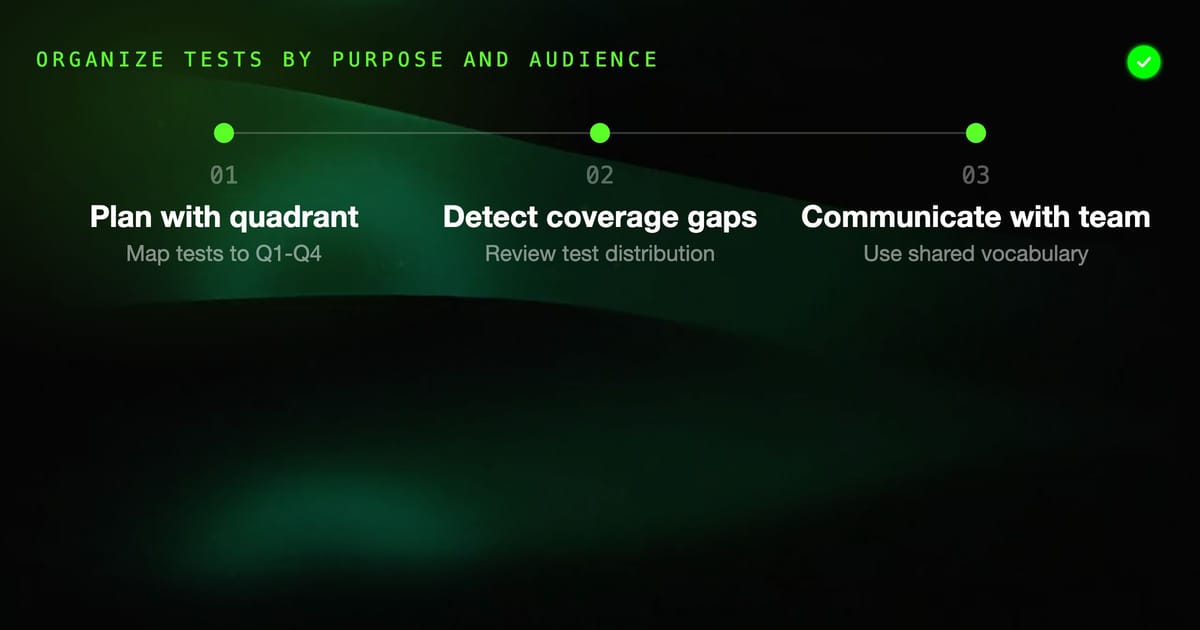
As a planning tool
When planning a sprint or release, map your testing activities to the quadrant:
- Q1: What unit and integration tests do we need for the new code?
- Q2: What acceptance criteria can we automate?
- Q3: What exploratory testing should we schedule?
- Q4: What performance/security requirements need validation?
As a coverage gap detector
If your team only does Q1 (unit tests), you have gaps in Q2, Q3, and Q4. If your team only does Q3 (manual testing), you're missing the fast feedback of Q1.
A healthy test strategy covers all four—with different levels of investment based on risk.
As a communication tool
The quadrant gives testers and developers a shared vocabulary. "This is a Q3 activity" communicates more than "this is manual testing"—it explains why it's manual and what role it plays.
Common Misconceptions
"Q3 is just legacy manual testing." No—Q3 is irreplaceable. It catches what automation can't, and it's where user empathy lives.
"Q1 replaces Q2." Unit tests verify code; acceptance tests verify features. Both are needed.
"Q4 is optional." Only until you have a performance incident in production.
The Quadrant in Modern Testing
The Agile Testing Quadrant was designed for agile teams, but it applies to any software organization. The labels shift:
- Startups: Heavy Q1, light Q4 (until scale matters), some Q3
- Regulated industries: Heavy Q2 (compliance), Q4 (security/load), systematic Q3
- Consumer products: Heavy Q3 (UX), Q2 (feature validation), Q4 (performance at scale)
Where HelpMeTest Fits
HelpMeTest operates in Q2 and Q3. Plain-English test scenarios that verify features from the user's perspective—automated (Q2) but written in business terms, close to exploratory testing (Q3).
HelpMeTest lets QA teams write acceptance tests in plain English without code, run them against real browsers, and get 24/7 monitoring. It bridges the gap between Q1 automation (developer-written) and Q3 human testing (manual, slow).
Summary
| Quadrant | Facing | Role | Examples |
|---|---|---|---|
| Q1 | Technology | Supporting | Unit tests, integration tests |
| Q2 | Business | Supporting | Acceptance tests, story tests |
| Q3 | Business | Critiquing | Exploratory testing, UAT |
| Q4 | Technology | Critiquing | Performance, security, load |
The Agile Testing Quadrant doesn't tell you how many tests to write—it tells you why you're writing them and who they serve. With that clarity, your test strategy becomes intentional rather than instinctual.